Find the value of csc$\frac{16\pi}{3}$.
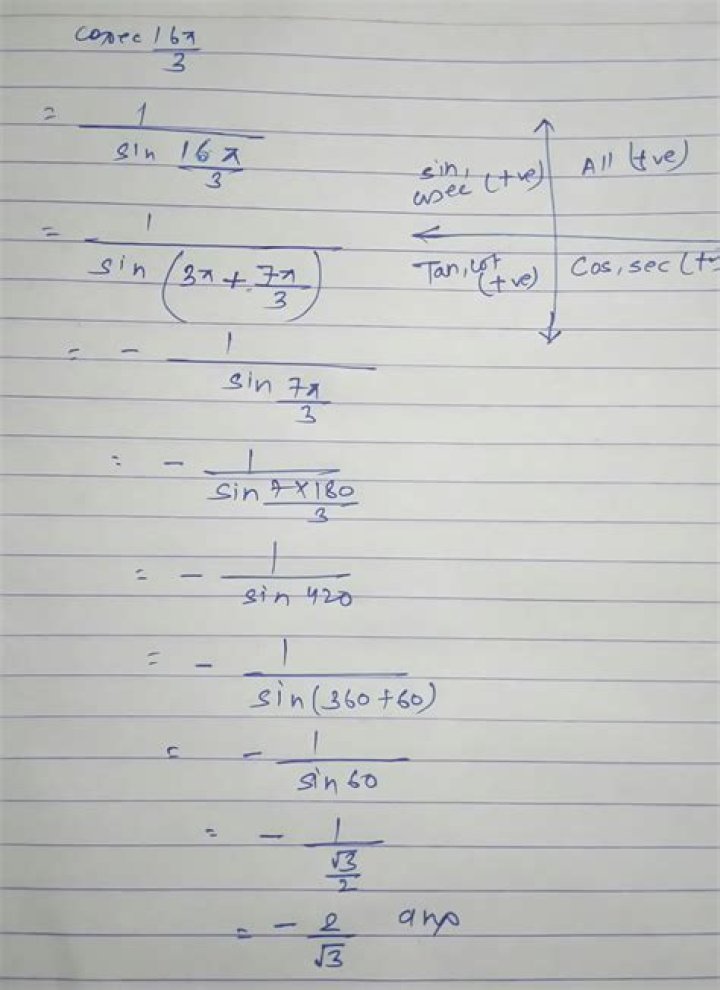
Q. Find the value of csc$\frac{16\pi}{3}$.
A. This angle is equal to two full revolutions plus $\frac{4\pi}{3}$. I got this by subtracting, $\frac{16\pi}{3} - 4\pi = \frac{16\pi}{3} - \frac{12\pi}{3} = \frac{4\pi}{3}$. The terminal side is in Quadrant III. The reference angle is $\frac{4\pi}{3} - \pi = \frac{\pi}{3}$. The cosecant of $\frac{\pi}{3}$ is $\frac{2\sqrt{3}}{3}$. Using the negative, the answer is $-\frac{2\sqrt{3}}{3}$.
My questions:
is how do one tell how many revolutions it takes, based off the fraction they give?
And how does one find the cosecant of $\frac{\pi}{3}$? On the calculator I use sine and then take the reciprocal of sine, but sine come out to $.018276028$. And I'm not sure on how to get the reciprocal from that or even find the cosecant of that number.
$\endgroup$ 44 Answers
$\begingroup$Consider the angle $960^\circ$. I can easily break this down into $$360^\circ + 360^\circ + 180^\circ + 60^\circ$$ knowing that $360^\circ$, $180^\circ$, and $60^\circ$ are a full revolution, half revolution, and an acute angle, respectively. Instead of making a "note to self" regarding the number of revolutions, let's just make it a bit more explicit by expressing the angle as a multiple of $180^\circ$. $$960^\circ = 720^\circ + 180^\circ + 60^\circ = \frac{720^\circ + 180^\circ + 60^\circ}{180^\circ}\cdot 180^\circ = (4+1+\frac{1}{3})180^\circ$$ And instead of saying to myself $(4+1+\frac{1}{3})180^\circ$, I'll say instead, $(4+1+\frac{1}{3})\text{"Half-Revolutions"}$.
Were the angle expressed in Radians, instead, I would do much the same thing. $$\frac{16\pi}{3} = \frac{16}{3}\pi = (\frac{12 + 3 + 1}{3})\pi= (4 + 1 + \frac{1}{3})\pi = (4+1+\frac{1}{3})\text{"Half-Revolutions"}$$
I prefer the "half-revolution" approach because of it's one-to-one correspondence with the angle $\pi$ (when expressed in Radians).
Now that I have an idea of what the angle is (in revolutions), I may try to plot it.
The green spiral shows my 4 half-revolutions, the red curve my single half revolution, and the blue my reference angle. Now, to find the $\csc \frac{16}{3}\pi$, just find the $\sin \frac{16}{3}\pi$ and take its reciprocal.
$$\csc \frac{16}{3}\pi = \frac{1}{\sin \frac{16}{3}\pi}=\frac{1}{-\frac{\sqrt{3}}{2}} = \frac{1}{-\frac{\sqrt{3}}{2}}\cdot \frac{-\frac{2}{\sqrt{3}}}{-\frac{2}{\sqrt{3}}} = \frac{-\frac{2}{\sqrt{3}}}{1} = -\frac{2}{\sqrt{3}}$$
$\endgroup$ $\begingroup$Just observe that $16=5\cdot 3+1$.
The cosecant of $16\pi/3$ is the reciprocal of the sine; from $16=5\cdot3+1$, we get $$ \frac{16\pi}{3}=5\pi+\frac{\pi}{3}=\pi+\frac{\pi}{3}+4\pi $$ you have $$ \sin\frac{16\pi}{3}=\sin\left(\pi+\frac{\pi}{3}\right)= -\sin\frac{\pi}{3}=-\frac{\sqrt{3}}{2} $$ Therefore $$ \csc\frac{16\pi}{3}=-\frac{2}{\sqrt{3}}=-\frac{2\sqrt{3}}{3}\approx-1.1547 $$
You probably had the calculator set to angles in degrees, rather than radians.
In a right triangle having one angle of $\pi/3$, the other acute angle is $\pi/6$. Thus the triangle is half of an equilateral triangle, and so $\cos\frac{\pi}{3}=\frac{1}{2}$. With Pythagoras' theorem, $\sin\frac{\pi}{3}=\frac{\sqrt{3}}{2}$.
A formula for determining the quadrant containing an angle $\theta$ when $\theta$ is not an integer multiple of $\frac{\pi}{2}$ (the quadrantal angles) is
\begin{equation} Q\left(\theta\right)=\left(\left\lfloor\frac{2\theta}{\pi} \right\rfloor\mod{4}\right)+1 \end{equation}
For example,
\begin{eqnarray} Q\left(\frac{16\pi}{3}\right)&=&\left(\left\lfloor\frac{32\pi}{3\pi} \right\rfloor\mod{4}\right)+1\\ &=&(10\mod{4})+1\\ &=&2+1=3 \end{eqnarray}
and
\begin{eqnarray} Q\left(-\frac{16\pi}{3}\right)&=&\left(\left\lfloor-\frac{32\pi}{3\pi} \right\rfloor\mod{4}\right)+1\\ &=&(-11\mod{4})+1\\ &=&1+1=2 \end{eqnarray}
Notice this. Quite simple approach