Find the inverse function $x + \sqrt {x}$
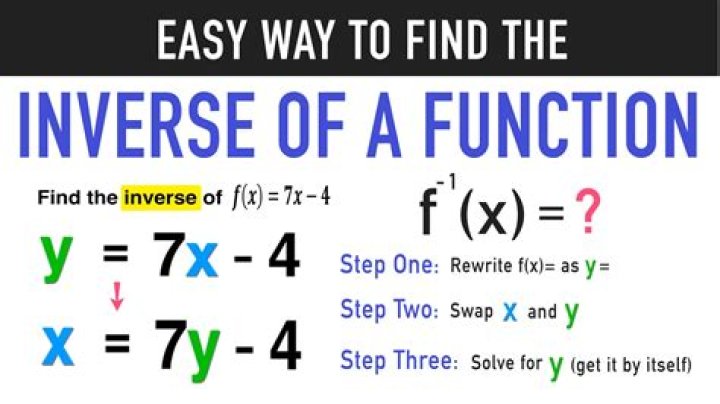
$ Y = x + \sqrt {x} $
Hello , I want to find the inverse function of this function , I know that it's injective How to prove the $f(x) = \sqrt{x + \sqrt{x}}$ is injective. but do not know how to make the inverse function step by step.
$\endgroup$ 14 Answers
$\begingroup$Thanks to the @egreg 's answer I found an easier solution :
add $ +\frac{1}{4} - \frac{1}{4}$ we have : $$y = x + \sqrt{x} +\frac{1}{4} - \frac{1}{4}$$ then : $$y=(\sqrt{x}+\frac{1}{2})^2-\frac{1}{4}$$ $\sqrt{x} + \frac{1}{2}$ is clearly positive so : $$(\sqrt{y+{\frac{1}{4}}}-\frac{1}{2})^2=x$$ then : $$x = y + \frac{1}{2}-\sqrt{y+{\frac{1}{4}}}$$ you can swap x and y to have the inverse function.
Because the range of the function is $y ≥ 0$ we have $x ≥ 0$ for the inverse function domain.
Which is equal to this answer
$\endgroup$ $\begingroup$This is basically Andrés comment elaborated:
Note that $f = g \circ h$ where $g(x) = x^2+x, h(x) = \sqrt x$, both $g,h$ are invertible on $[0,\infty)$.
Then $f^{-1} = h^{-1} \circ g^{-1}$.
Computing $h^{-1}$ is straightforward, computing $g^{-1}$ involves solving a quadratic.
$\endgroup$ $\begingroup$Given $y$, you need to find $x\ge0$ such that $y=x+\sqrt{x}$ or $$ y-x=\sqrt{x} $$ A necessary condition is $(y-x)^2=x$, which becomes $$ y^2-2xy+x^2=x $$ or $$ x^2-(2y+1)x+y^2=0 $$ Can you find $x$ from this? Which one of the two solutions have you to consider?
Note that the condition $y-x=\sqrt{x}$ implies $y\ge x$, so the solution you must choose is the only one that satisfies $y\ge x$.
$\endgroup$ 5 $\begingroup$Since you know that the function is injective, only one solution is acceptable; the two roots are $x_1=\dfrac{2y+1+\sqrt{4y+1}}{2}$ and $x_2=\dfrac{2y+1-\sqrt{4y+1}}{2}$. The first one is clearly greater than $y$, so we have $x=\dfrac{2y+1-\sqrt{4y+1}}{2}$, which is acceptable only for $y\ge0$. Indeed from $\dfrac{2y+1-\sqrt{4y+1}}{2}\le y$ we get $2y+1-\sqrt{4y+1}\le 2y$ or $1\le\sqrt{4y+1}$. So the inverse function is $y\mapsto \dfrac{2y+1-\sqrt{4y+1}}{2}$, defined for $y\ge0$.
To make this easier, let $t = \sqrt{x}$ with the condition $t \ge 0$. Then we get
$$y = t^2 + t $$
or
$$ t^2 + t - y = 0 $$
This is simply a quadratic equation in $t$ that you can solve. There are two roots, but you can only take the positive one. The solution is:
$$t = \frac{-1 + \sqrt{1+4y}}{2}$$
Then it just takes some algebra to find $x = t^2$
$\endgroup$