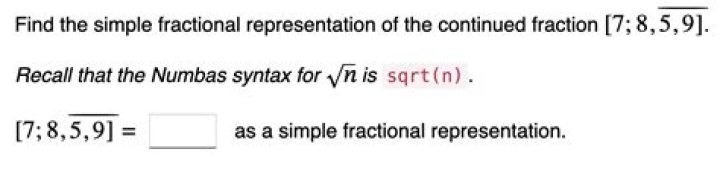
Find the fractional representation
Find the fractional representation 𝑝/𝑞, with 𝑝∈ℕ and 𝑞∈ℕ, of the rational number whose decimal representation is:
83.613333....
Can someone please explain step by step on how to solve this kind of question?
Thank you.
$\endgroup$ 44 Answers
$\begingroup$Let $x=83.61\dot 3$
$$\begin{align} \qquad100x &=8361.33\dot 3\\ (-) \qquad x &=83.61\dot 3\\ 99x &= 8277.72\\ 9900x &= 827772\\ 75x &= 6271\\ x &=\dfrac {6271}{75} \end{align}$$
$\endgroup$ $\begingroup$If you meant (exactly) $83.613333$ (as the question was before you edited it), then the fractional representation is $\frac{83613333}{1000000}$
Algorithm: for finite representations, just shift the decimal point to the right till you get a whole number with digit string $F$, count how many times $N$ you shifted to get to the whole number, and put $F$ on the numerator and put in the denominator a one followed by $N$ zeroes (which is $10^N$) to get $\frac{F}{10^N}$. Reduce to lowest terms by dividing top and bottom by common factors as needed. In the above example, $F = 83613333, N = 6$.
If you meant (as I suspect) $83.61\overline 3$, which means the "$3$" at the end goes on forever, then the fractional representation is $\frac{8361}{100} + \frac{3}{900} = \frac{6271}{75}$.
Algorithm: for non-terminating periodic representations, consider the "fixed" part as a digit string ($F$) first, and apply the above algorithm to get $\frac F{10^N}$. For the recurring periodic part with digit string $P$, consider the length of the period $M$. The denominator of the periodic part will be $M$ nines in sequence (which will be $10^M-1$) multiplied by $10^N$ to take into account the shift of decimal places to get the start of the periodic portion immediately to the right of the decimal point. The final answer for the entire number will be $\frac F{10^N} + \frac P{(10^M-1)(10^N)}$. In the above example, $F = 83, N = 2, P = 3, M = 1$
$\endgroup$ 3 $\begingroup$In general you will have a decimal expansion of a rational number with some fixed part and a repeating part. The way to solve these is to first set $x$ equal to the number, then multiply by some power of ten to make the fixed part an integer then subtract from the original expression to remove the infinite expansion at the end. Lets do your case.
So first, we set $x=83.613333...$ then identify that the fixed portion is $83.61$ and the repeating part follows. To make this an integer we have to multiply by $10^2=100$ so we get the equation $100x = 8361.3333....$ which has only the repeating portion after the decimal.
To get rid of the repeating portion we now calculate $$100x-x = 99x = 8361.3333... - 83.6133333... = 8361.33 - 83.61=8277.72$$ from here we again remove the decimal portion by multiplying both sides by $10^2$ which gives us $9900x = 827772$. From here we solve for $x$ giving us $827772/990 = 6271/75$.
$\endgroup$ $\begingroup$subtract the finite part from the number, and in the denominator, you add a 9 for each infinite decimal and a 0 for each finite decimal$$83.61\overline{3}=\frac{83613-8361}{900}=\frac{6271}{75}$$
$\endgroup$