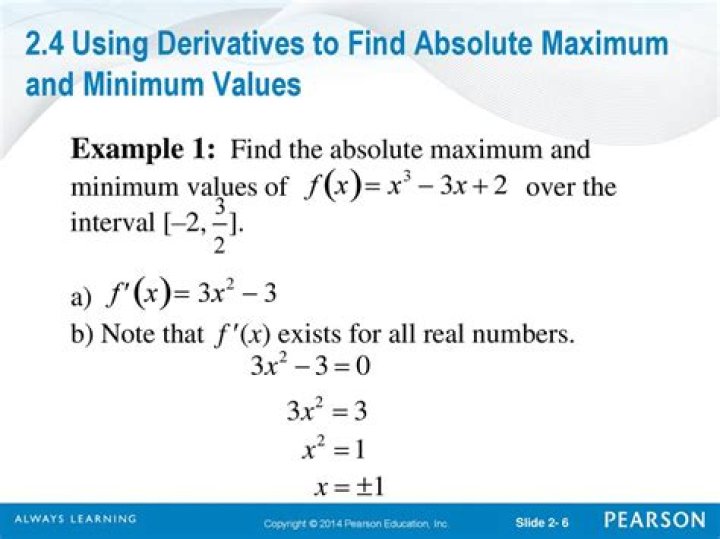
Find the absolute min and max value on given interval
$f(t) = t\sqrt{16 − t^2}$ on interval $[−1, 4]$. I was able to find the critical points which are 2√2 and -2√2. All was left for me to do was to evaluate both my critical and end points into the given function. I ended up with the points: $(-1,-3.87) ; (4,0) ; (2\sqrt2,33.94)$ and $(-2\sqrt2,-8)$
I thought the absolute minimum value had to be $(-2\sqrt2,-8)$ and the absolute maximum value was $(2\sqrt2,33.94)$ but apparently this is incorrect. Where did I go wrong?
$\endgroup$1 Answer
$\begingroup$The first issue is that $-2 \sqrt{2}$ is not in the interval [-1,4]. However, $2\sqrt{2}$ is indeed a critical point, as $$\frac{\mathrm{d}f}{\mathrm{d}t} = \sqrt{16-t^2} -\frac{t^2}{\sqrt{16-t^2}} = \frac{16-2t^2}{\sqrt{16-t^2}}$$ which is zero at $t=2\sqrt{2}$. Now our possible candidates for the absolute minima and maxima are $t = -1, 2\sqrt{2}, 4$. Evaulating, we obtain $f(-1) = -\sqrt{16-1} = -\sqrt{15}$, $f(2\sqrt{2}) = 2\sqrt{2}(\sqrt{16-8}) = 8$ and $f(4) = 4\sqrt{16-16} = 0$. Thus, our absolute minimum value is $-\sqrt{15}$ at $t=-1$ and our absolute maximum value is $8$ at $t=2\sqrt{2}$.
$\endgroup$