Find directions in which f increases and decreases the most rapidly. Then find the derivatives of f at these directions. [closed]
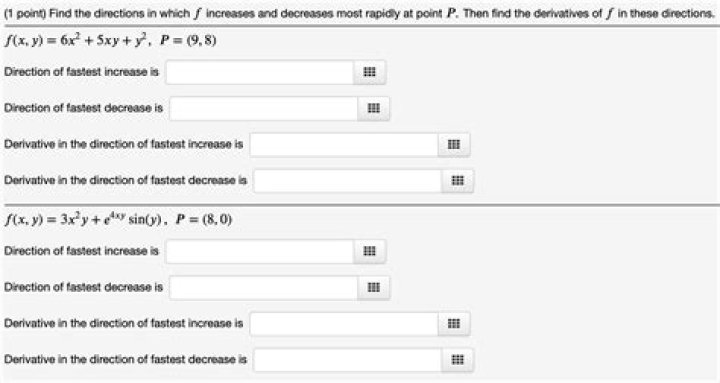
$f(x,y)=3x^2+2xy+4y^2$
This is what I have to find:
direction of fastest increase
I found the gradient vector:
$f(x,y)=(6x+2y)i+(2x+8y)j$
$f(9,2) = \langle 58,34\rangle$
Is this the direction of fastest increase? Or is it $\frac{58}{2\sqrt{1130}}$i,$\frac{34}{2\sqrt{1130}}$j
direction of fastest decrease
Is this the direction of fastest increase?$\frac{-58}{2\sqrt{1130}}$i,$\frac{-34}{2\sqrt{1130}}$j
derivative in direction of fastest increase
I know this the dot product but I dont know what vectors to use.
derivative in direction of fastest decrease
$\endgroup$ 01 Answer
$\begingroup$The direction of fastest increase is in the same direction of the gradient vector at that point. If you think about it geometrically, you'll know that the $\nabla F$ at a point is perpendicular to the level surface/contour path. So it is correct that $\nabla$ also indicates that direction. The direction of the fastest decrease is just $-\nabla$ at $P$.
For the second part of you question use the formula of Directional Derivatives where $$D_u f(x,y)= f_x(x,y)a+f_y(x,a)b$$ where $<a,b>$ is the unit vector of your direction.
So that means $$D_u f(x,y)= (6x+2y)\frac{58}{2 \sqrt{1130}}+(2x+8y)\frac{34}{2 \sqrt{1130}}$$
You can substitute your Point in for $x$ and $y$ and solve. You should get $$58(\frac {58} {2\sqrt{1130}}) + 34(\frac {34} {2\sqrt{1130}})$$
Similarly you use the same method to determine the derivative in the direction of the fastest decrease.
NB: you can only substitute a point in for $x$, and $y$ if the question specifically states that it only needs to be calculated at that point. If not, the general solution (leaving it in $x$ and $y$) has to be used as that would give the derivative of greatest increase/decrease for all points.
$\endgroup$ 12