Find all $x \in\mathbb R^4$ that are mapped into the zero vector by the transformation $x \mapsto Ax$
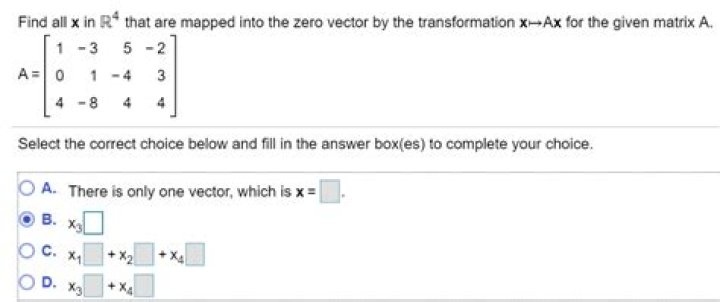
I have the following problem: "Find all $x \in\mathbb R^4$ that are mapped into the zero vector by the transformation $x \mapsto Ax$ for the given matrix $A.$"
$$A = \begin{bmatrix}1 & -3 & 4 & -4\\0 & 1 & -4 & 4\\2 & -4 & 0 & 0\end{bmatrix}$$
The textbook I have only has examples of square matrices up to $\mathbb R^4$ being transformed, but I need to transform a $3\times 4$ matrix. Additionally, it doesn't really show the steps, just the start and end product, and I'm not understanding the jump.
Thanks for the help!
$\endgroup$ 42 Answers
$\begingroup$The method is Gaussian elimination: $$\begin{bmatrix}1 & -3 & 4 & -4\\0 & 1 & -4 & 4\\2 & -4 & 0 & 0\end{bmatrix}\sim \begin{bmatrix}1 & -3 & 4 & -4\\0 & 1 & -4 & 4\\0 & 2 & -8 & 8\end{bmatrix}\sim \begin{bmatrix}1 & -3 & 4 & -4\\0 & 1 & -4 & 4\\0 & 0 & 0 & 0\end{bmatrix}\sim \begin{bmatrix}1 & 0 & -8 & 8\\0 & 1 & -4 & 4\\0 & 0 & 0 & 0\end{bmatrix}$$ This yields the equations $x_1=8x_3-8x_4$ and $x_2=4x_3-4x_4$. We have two free variables (the right side): $x_3$ and $x_4$. So first choose $x_3=1$ and $x_4=0$, then $x_3=0$ and $x_4=1$ to get solutions of the form $$\begin{bmatrix}x_1\\ x_2\\ x_3\\ x_4\end{bmatrix}=c_1\begin{bmatrix}8\\ 4\\ 1\\ 0\end{bmatrix}+c_2\begin{bmatrix}-8\\ -4\\ 0\\ 1\end{bmatrix}$$ with $c_1,c_2\in\mathbb{R}$.
In the first line, we basically simplify $$\left\{\begin{matrix}1x_1 & -3x_2 & +4x_3 & -4x_4 & = & 0\\ & +x_2 & -4x_3 & +4x_4& = & 0\\2x_1 & +x_2 & +0 & +0& = & 0\end{matrix}\right.$$ to $$\left\{\begin{matrix}1x_1 & +0 & -8x_3 & +8x_4 & = & 0\\ & x_2 & -4x_3 & +4x_4& = & 0 \end{matrix}\right.$$
$\endgroup$ 2 $\begingroup$We can solve the $Av=0$ (This is the definition of nullspace/kernel) with Gaussian elimination.
I'll be looking for $v$ in the following form: $v=\left(
\begin{array}{cccc}
a \\
b \\
c \\
d \\
\end{array} \right)$
$$\left(\begin{array}{cccc|c}
1 & -3 & 4 & -4 & 0 \\
0 & 1 & -4 & 4 & 0 \\
2 & -4 & 0 & 0 & 0 \\
\end{array}\right)$$
Moving the last column to the other side (It will be multipled by $-1$, and we can call it $p$ for example, so $d=p$):
$$\left(\begin{array}{ccc|cc}
1 & -3 & 4 & 0 & 4 \\
0 & 1 & -4 & 0 & -4 \\
2 & -4 & 0 & 0 & 0 \\
\end{array}\right)$$
Subtracting 2 times the first row from the third:
$$\left(\begin{array}{ccc|cc}
1 & -3 & 4 & 0 & 4 \\
0 & 1 & -4 & 0 & -4 \\
0 & 2 & -8 & 0 & -8 \\
\end{array}\right)$$
Subtracting 2 times the second row from the third:
$$\left(\begin{array}{ccc|cc}
1 & -3 & 4 & 0 & 4 \\
0 & 1 & -4 & 0 & -4 \\
0 & 0 & 0 & 0 & 0 \\
\end{array}\right)$$
Removing the last row:
$$\left(\begin{array}{ccc|cc}
1 & -3 & 4 & 0 & 4 \\
0 & 1 & -4 & 0 & -4 \\
\end{array}\right)$$
Moving the last column to the other side again (naming it $q$, so $c=q$):
$$\left(\begin{array}{cc|ccc}
1 & -3 & 0 & 4 & -4 \\
0 & 1 & 0 & -4 & 4 \\
\end{array}\right)$$
Adding 3 times the second row to the third:
$$\left(\begin{array}{cc|ccc}
1 & 0 & 0 & -8 & 8 \\
0 & 1 & 0 & -4 & 4 \\
\end{array}\right)$$
So the solution is:
$$\left\{
\begin{array}{llll}
a=0-8p+8q \\
b=0-4p+4q \\
c=q \\
d=p \\
\end{array} \right.$$
or:
$v=\left(
\begin{array}{cccc}
0 \\
0 \\
0 \\
0 \\
\end{array} \right)+\left(
\begin{array}{cccc}
-8 \\
-4 \\
0 \\
1 \\
\end{array} \right)p+\left(
\begin{array}{cccc}
8 \\
4 \\
1 \\
0 \\
\end{array} \right)q=\left(
\begin{array}{cccc}
8q-8p \\
4q-4p \\
q \\
p \\
\end{array} \right)$