Explanation of backwards substitution in Gaussian elimination
I'm not sure what the back subsitution is doing on Gaussian Elimination...
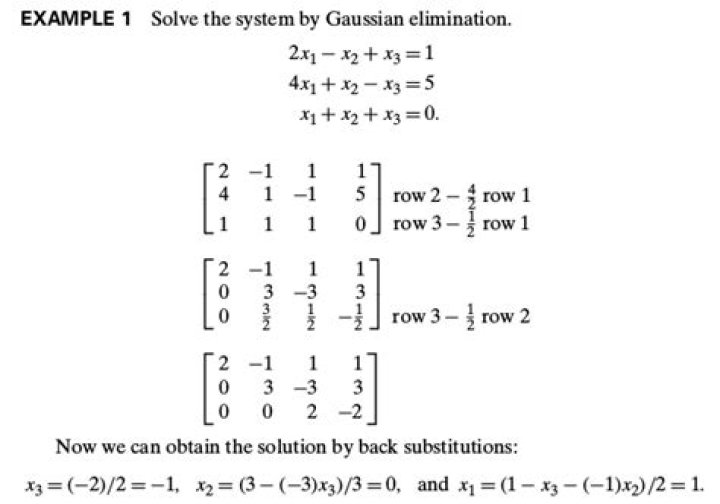
I understand how it is trying to get the upper triangular matrix with the 0s under the diagonal, and so I get the why we're doing row2 - 4/2 row1 etc.
I just don't understand the back substitution, like why do (-2)/2 to get x3, why do (3-(-3)x3/3 to get x2 etc like where are those numbers coming from and why.
I just like to know why the book is doing what its doing, but it didn't really explain what it was doing to get x3, x2, x1.
$\endgroup$2 Answers
$\begingroup$The last matrix represents the following system (which is equivalent to the original system): $$\begin{align} 2x_1 -x_2 +x_3 &= 1 \\ 3x_2 - 3x_3 &= 3 \\ 2x_3 &= -2 \end{align}$$
The logic behind back substitution should be clear now. We repeatedly substitute the values (or expressions) found for $x_{i+1}, x_{i+2} \ldots x_{n}$ back into the equation containing $x_i$ until all variables have been solved for: $$\begin{align} x_3 &= \frac{-2}{2} = -1 \\ x_2 &= \frac{3+3x_3}{3} = \frac{3+3(-1)}{3} = 0\\ x_1 &= \frac{1+x_2-x_3}{2} = \frac{1 + 0 -(-1)}{2} = 1 \end{align}$$
$\endgroup$ $\begingroup$The term "back-substitution" means exactly that: substitute $x_3 = -1$ back into the other two original equations (or the equivalent system given by the last matrix after row-reducing) to solve for the other variables.
For instance, $x_2 = (3-(-3)x_3)/3 = 0$ is obtained by reading the second-to-last line of the last matrix as $3x_2 - 3x_3 = 3$, and substituting our solution $x_3 = -1$ into that, and solving for $x_2$ gives what the book is saying.
$\endgroup$