Evaluating a flux integral by the use of divergence theorem
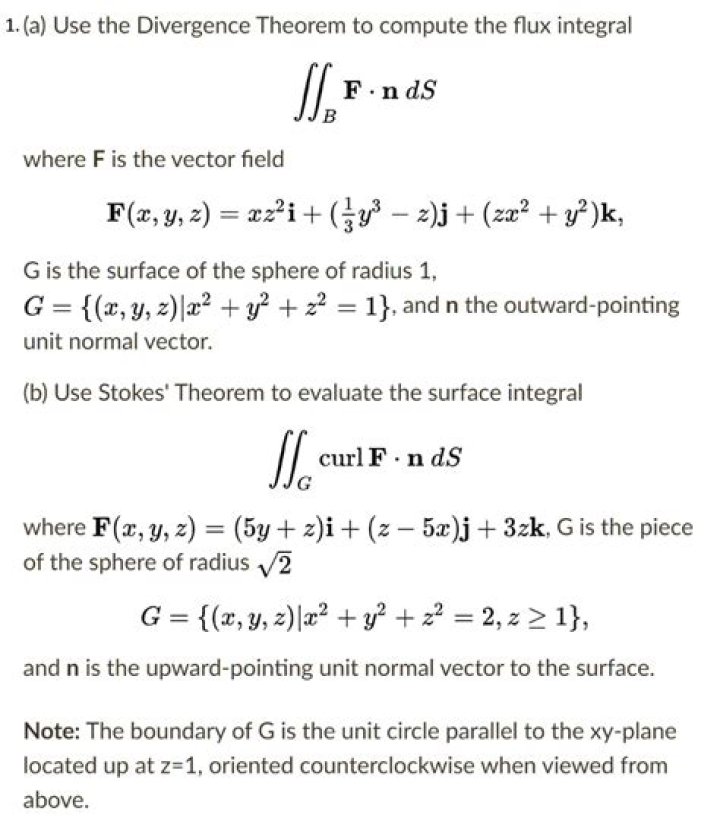
The sphere $x^2+y^2+z^2=25$ is intersected by the plane $z=3$. The smaller portion forms a solid V bounded by a closed surface $S_0$ made up of two parts, a spherical part $S_1$ and a planar part $S_2$. Let $n=(\cos\alpha,\cos\beta,\cos\gamma$) denote the unit normal. Evaluate the surface integral:
$\int \int (xz.\cos\alpha+yz.\cos\beta+\cos\gamma)dS$ if S is the spherical cap $S_1$.
I have an attempt, but my response doesn't match $144\pi$:
We have that $F(x,y,z)=(xz,yz,1)$. So, div F = $2z$. Using the divergence theorem, we have the following equality:
$ I = \int \int F\cdot dS = \int \int \int (2z)dxdydz$
Transforming this integral into spherical coordinates, we have:
$I= \int \int \int (2p^3\cos\varphi \sin\varphi)d\varphi d\theta dp$
The limits of integration shall be the following:
$0\leq \theta \leq 2\pi, 0\leq p \leq 5, \cos^{-1}(3/5) \leq \varphi \leq \pi$ .
Evaluating the integral I find $-200\pi$. What did I do wrong?
$\endgroup$ 62 Answers
$\begingroup$In spherical coordinates, $z=r\cos\phi =3$, so $r=\frac{3}{\cos \phi}$. Also, the plane and the sphere intersect when $z=\rho\cos\phi=3$ and $\rho=5$, which gives $\phi=\cos^{-1}\frac{3}{5}$.
So the bounds should be $$ 0\le \theta \le 2\pi, \quad 0 \le \phi \le \cos^{-1}\frac{3}{5}, \quad \frac{3}{\cos \phi} \le r \le 5 $$
When I compute the integral with these bounds, I get $128\pi$.
Alternatively, in cylindrical coordinates (easier):
$$ 0\le \theta \le 2\pi, \quad 3 \le z \le \sqrt{25-r^2}, \quad 0 \le r \le 4 $$
Again, the integrals equals $128\pi$.
$\endgroup$ 2 $\begingroup$I manage to find out an alternative solution. I will simply integrate into the cut-off sphere until $\varphi$ makes an angle $cos^{-1}\varphi = 3/5$. This will leave off a cone, which i shall integrate later.
So, $I_1= \int \int \int (2p^3\cos\varphi \sin\varphi)\ d\varphi \ d\theta \ dp $ with the following limits of integration:
$0\leq \theta \leq 2\pi, 0\leq p \leq 5, \cos^{-1}(3/5) \leq \varphi \leq \pi$
gives us the value $-200 \pi$. Since we are considering the unit outer normal, and the integral evaluated consider the outer normal in the oposite way, we have that $I_1= 200 \pi$.
Now we are going to evaluate the integral over the remaining cone. The cone is described by $x^2+y^2 = 16/9z^2$, and hence in terms of cylindrical coordinates we have the integral:
$I_2= \int \int \int 2zr\ \ dr \ dz \ d\theta$ with the following limits of integration:
$0\leq \theta \leq2\pi, 0\leq z \leq3, 0\leq r \leq 4/3z $
which gives us $72\pi$. Thus, with the correct orientation we have $-72\pi$
Adding up $I_1+I_2= 128\pi$, as already find by our friend.
$\endgroup$