Evaluate the integral of $\ln(1-x^5)$ as a power series
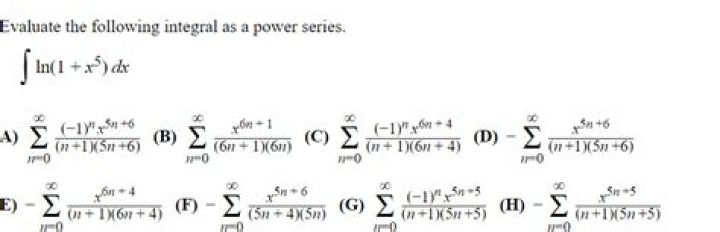
Evaluate the following integral as a power series. $$ \int \ln\left(1-x^5\right)dx $$
The correct answer is below, but I only understand why some parts of it are correct. $$ - \sum_{n=0}^{\infty} \frac{x^{5n+6}}{(n+1)(5n+6)} $$
Here’s where I get to:
Replace $x^5$ with $t$. Then start with a geometric series of $a=1$ and $r=t$. $$ \frac{1}{1-t} = \sum_{n=0}^{\infty}t^n = 1 + t + t^2 + \dots $$
Integrate both sides.
$$ -\ln(1-t)=\sum_{n=0}^{\infty}\frac{t^{n+1}}{n+1} = t+\frac{t^2}{2}+\frac{t^3}{6}+\dots\\ \ln(1-t)=-\sum_{n=0}^{\infty}\frac{t^{n+1}}{n+1} =-\left[ t+\frac{t^2}{2}+\frac{t^3}{6}+\dots\right] $$
At this point I’m fairly certain that this is not an alternating series and that the $-1$ coefficient outside the sum in the answer is correct.
Integrate again, except I’m unsure where this leads me. I’m not sure how to integrate the $\frac{t^{n+1}}{n+1}$ nor how the expanded series becomes $\frac{x^{5n+6}}{(n+1)(5n+6)}$.
$$ \int \ln(1-t)dt=-\left[\frac{t^2}{2}+\frac{t^3}{6}+\frac{t^4}{24}+\dots\right] $$
Typing this out has led me to think the following but I don’t feel very confident about it. I know the following theorem,
$$ f(x) = \sum_{n=0}^{\infty} c_n(x-a)^n\\ \int f(x) dx = C + \sum_{n=0}^{\infty} c_n\frac{(x-a)^{n+1}}{n+1} $$
Does this mean that if I have $\sum \frac{t^{n+1}}{n+1}$ I could say the following?
$$ \sum_{n=0}^{\infty} \frac{1}{n+1}(x^5)^{n+1} \Rightarrow c_n = \frac{1}{n+1} $$
Then integrating,
$$ \sum_{n=0}^{\infty} \frac{1}{n+1} \frac{x^{5n+5+1}}{5n+5+1}=\sum_{n=0}^{\infty} \frac{x^{5n+6}}{(n+1)(5n+6)} $$
This gives me the part of the complete answer that I understand. Something about this feels off to me, though. Have I jumped ahead somewhere? Why can I sub $x^5$ back in at that intermediate step but not after?
$\endgroup$ 11 Answer
$\begingroup$You've made an error when you integrated the series representation of $\log (1-t)$. The issue here is that the original integral is with respect to $x$: $$\int \log (1-x^5) \, dx,$$ not with respect to $x^5$, which is what you had calculated when you wrote $$\int \log (1-t) \, dt.$$ In other words, you must substitute $t = x^5$ before you perform the integration step. Then you integrate the resulting series term by term.
$\endgroup$