Effect of adding a constant to both Numerator and Denominator
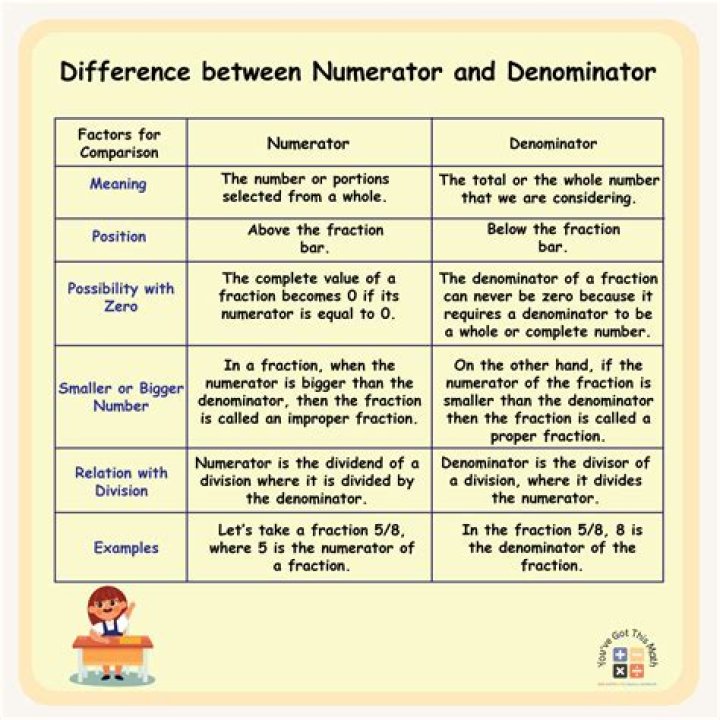
I was reading a text book and came across the following:
If a ratio $a/b$ is given such that $a \gt b$, and given $x$ is a positive integer, then $$\frac{a+x}{b+x} \lt\frac{a}{b}\quad\text{and}\quad \frac{a-x}{b-x}\gt \frac{a}{b}.$$
If a ratio $a/b$ is given such that $a \lt b$, $x$ a positive integer, then $$\frac{a+x}{b+x}\gt \frac{a}{b}\quad\text{and}\quad \frac{a-x}{b-x}\lt \frac{a}{b}.$$
I am looking for more of a logical deduction on why the above statements are true (than a mathematical "proof"). I also understand that I can always check the authenticity by assigning some values to a and b variables.
Can someone please provide a logical explanation for the above?
Thanks in advance!
$\endgroup$ 28 Answers
$\begingroup$Let $a>b>0$ and $x>0$. Because $a>b$ and $x$ is positive, we have that $ax>bx$. Therefore $ab+ax>ab+bx$. Note that $ab+ax=a(b+x)$ and $ab+bx=b(a+x)$, so our inequality says that $$a(b+x)>b(a+x).$$ Dividing, we have that $$\frac{a}{b}>\frac{a+x}{b+x}.$$ The other inequalities have a similar explanation.
$\endgroup$ $\begingroup$HINT $\ $ View it as a mediant; geometrically, the diagonal of the parallelogram with sides being the vectors $\rm\:(a,b),\ (x,x)\:,\:$ noting that the slope of the diagonal lies between the slopes of the sides.
$\endgroup$ $\begingroup$Ok. Here is my intuition. Since the people have already added the formal proofs, i'll only give the intuition. Consider two guys a and b. a is a rich man and b is a poor man. Now you give both equal amount of money x. How is the relative monetary status of both changed? for a it doesn't add as much as it improves the state of b. Therefore the relative superiority of a over b has decreased.
$\endgroup$ $\begingroup$When $a>b,\;\; \text{with}\;\; x \in \mathbb Z, x > 0$ $$f(x)=\frac{a+x}{b+x}=1+\frac{a-b}{b+x}$$ is decreasing w.r.t. $x>-b$. It is an intuitive explanation, but I am not sure whether this is your logical explanation.
$\endgroup$ 1 $\begingroup$For the first question. If $x>0$, we have:
$$a>b\Rightarrow ax>bx\Rightarrow ab+ax>ab+bx\Rightarrow a(b+x)>b(a+x)$$
$$\Rightarrow \frac{a}{b}>\frac{a+x}{b+x}\Leftrightarrow \frac{a+x}{b+x}<% \frac{a}{b}.$$
Then $-x<0$. We thus have
$$a>b\Rightarrow -ax<-bx\Rightarrow ab-ax<ab-bx\Rightarrow a(b-x)<b(a-x)$$
$$\Rightarrow \frac{a}{b}<\frac{a-x}{b-x}\Leftrightarrow \frac{a-x}{b-x}>% \frac{a}{b}.$$
For the second question. If $x>0$, we have:
$$a<b\Rightarrow ax<bx\Rightarrow ab+ax<ab+bx\Rightarrow a(b+x)<b(a+x)$$
$$\Rightarrow \frac{a}{b}<\frac{a+x}{b+x}\Leftrightarrow \frac{a+x}{b+x}>% \frac{a}{b}.$$
Then $-x<0$. We thus have
$$a<b\Rightarrow -ax>-bx\Rightarrow ab-ax>ab-bx\Rightarrow a(b-x)>b(a-x)$$
$$\Rightarrow \frac{a}{b}>\frac{a-x}{b-x}\Leftrightarrow \frac{a-x}{b-x}<% \frac{a}{b}.$$
$\endgroup$ 2 $\begingroup$Let $a,b,x>0$ and $a>b$. Then
$$\frac{a+x}{b+x}=\frac{a+\frac{a}{b}x}{b+x}+\frac{(1-\frac{a}{b})x}{b+x}=\frac{a}{b}+(1-\frac{a}{b})\frac{x}{b+x}\leq\frac{a}{b}.$$
The other assertions can be shown similarly.
$\endgroup$ $\begingroup$How about something along these lines: Think of a pot of money divided among the people in a room. In the beginning, there are a dollars and b persons. Initially, everyone gets a/b>1 dollars since a>b. But new people are allowed into the room at a fee of 1 dollar person. The admission fees are put into the pot. The average will at always be greater than 1 but since each new person is not charged what he (or she) is getting back, the average will have to drop and so [ \frac{a+x}{b+x}<\frac ab.] Similar reasoning applies to the other inequalities.
$\endgroup$ $\begingroup$$$ \lim_{x\to 1} f(x)= \frac{a+x}{b+x} $$ where $a b \ne 0$.
As neither $a$ nor $b$ are zero the function $f(x)$ is continuous and differentiable for all $x$ belongs to $\mathbb{R}^{+}$ (positive real numbers).
As $x\to \infty$, $f(x) \to 1$.
As in our case $ x>0$ and $x\to \infty$ we observe that, if $\frac{a}{b}<1$ , $f(x)$ tends to $+1$ thereby $\frac{a}{b} < f(x)$ and if $\frac{a}{b} > 1$ , $f(x)$ tends to $+1$ thereby $\frac{a}{b} < f(x)$. Hope this helps!
$\endgroup$ 1