Domain of derivative
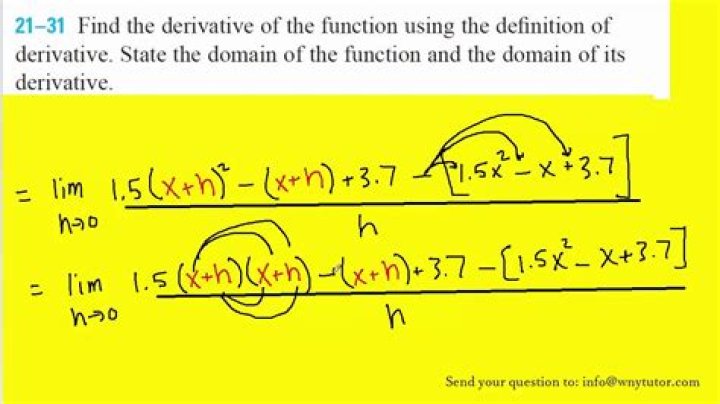
I know that given a certain function $f(x)$, there are some values of $x$ that could be in its domain but not in its derivative's. However, I believe that all the values that belong to the domain of $f'(x)$, have to belong to the domain of the original function as well.
Is this true? If yes, how can it be proved?
$\endgroup$2 Answers
$\begingroup$It depends on how you define the domain of $f'(x)$. For me the definition of the domain of $f'(x)$ is $$\mbox{dom}(f')=\left\{x\in\mbox{dom}(f): \lim_{h\to 0}\frac{f(x+h)-f(x)}{h}\ \ \ \mbox{exists and it is finite}\right\}$$ so $\mbox{dom}(f')\subseteq\mbox{dom}(f)$ by definition.
Note that $x$ must be an element of $\mbox{dom}(f)$ because you have to evaluate $f$ in $x$ to build the limit that define the derivative. (Hope it's clear, I don't speak english so well.)
An example. Consider $f(x)=\ln(x)$. Its domain is $\mbox{dom}(f)=(0, +\infty)$ and its derivative is $f'(x)=\frac{1}{x}$.
The "natural domain" of $y=\frac{1}{x}$ is $\mathbb{R}\setminus\{0\}$ while $\mbox{dom}(f')=(0, +\infty)$.
$\endgroup$ $\begingroup$Please read this question : Differentiable only on interior points
In fact in addition to Ixion's answer, $f'$ could be defined in $x_0$ if $x_0\in\operatorname{dom}(f)\cap\overline{\operatorname {dom}(f)\setminus\{x_0\}}$ because limits can only make sense in limit points.
How would you define $f'(-1)$ in this case ? $\begin{cases} f(-1)=5 \\ f(x)=x & x\ge 0\end{cases}$
But the initial inclusion $\operatorname{dom}(f')\subset\operatorname{dom}(f)$ holds, yes.
$\endgroup$