Does stacking o-rings provide the same result as using a thicker o-ring?
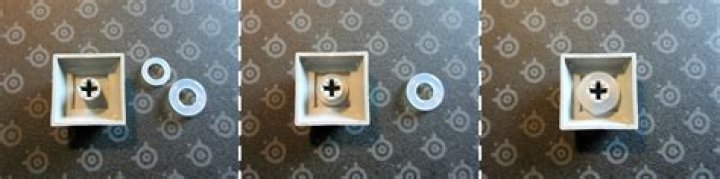
I plan to add o-rings in my mechanical keyboard. Does stacking o-rings provide the same result as using a thicker o-ring in terms of key travel, from the standpoint of the keyboard user?
The goal of adding o-ring is obtaining reducing key travel to be as low as possible (without having to hammer the keys for them to actuate).
For example, I could use two o-rings stacked on top of each other (1.5mm + 2.5mm) like this:
or directly use a 4mm o-ring.
Let's assume the o-rings have the same inner diameter, and are applied to a Cherry MX key switch. I am thinking of using 40A o-ring.
163 Answers
If the question is strictly about limiting key travel, it could be answered by simple arithmetic:
1.5mm + 2.5mm = 4.0mm Any combination of o-rings with the desired total thickness would yield essentially the same result and the question would be a trivial one.
However, the comments clarify the nature of the anticipated difference: the physics of the rings and impact on the user. So, I will assume that the question is about more than simply limiting travel, and is concerned with additional characteristics that would affect the user, like how key resistance would compare.
Start with the case of two 2mm thick rings. These would have different mechanics than one 4mm ring. Rings of unequal thicknesses would have still different mechanics, but none of that would necessarily make a difference in key characteristics.
Think of the cross section. Two 2mm thick rings would have 1/2 the material of one 4mm ring, and theoretically, you could stack them so that the thickest portions were concentric. The reduced material would provide less resistance to compression than a single 4mm ring.
If the rings are of unequal thickness and the same inner or outer diameter, one will nest inside the other. Now, in addition to compression, you will have other dynamics, like stretching of the outer ring. However, the total material will be closer to that of a single 4mm ring. So the mechanics get very complicated, and you can get situations like less resistance to compression up to a point, then more resistance (compared to two equal rings).
The elasticity of the material will effect the dynamics, and many materials have different characteristics under stretching and compression. So all of those factors affect how it will behave outside the keyboard.
Now stick this system inside a keyboard. The key stem and the cavity under the key limit how much the ring material can move/spread. This is basically beyond the ability to calculate a result except perhaps by simulation.
But you still aren't at an answer. What role is this playing in the key mechanics? You still have to be able to actuate the key, so there is a narrow range of sizes and materials that will allow sufficient motion for the key to work. Once you have that, it affects how far the key will travel as a function of how much pressure you exert, and there are limits to travel.
So while the mechanics of ring combinations are different, you could still end up in a working range where the difference has no effect on what happens with the key.
The only practical way to determine an answer is to experiment.
As most have mentioned, it would very unlikely have any impact and I agree with them.
It decreases travel distance significantly and the key can end up being 'mushy'. While some people like that feeling most don't so O-rings aren't really that popular.
GMK produces QMX Clips which result in similar silencing performance, at a greatly decreased effect on travel distance.
There are also landing pads, which are basically small foam cut outs that sit around the key on the plate, although they are quite cheap, your mileage may vary as they aren't the best solution. I'd go with QMK clips if I were you