Does $\sqrt{x}$ have a limit for $x \to 0$?
I am taking a calculus course, and in one of the exercises in the book, I am asked to find the limits for both sides of $\sqrt{x}$ where $x \to 0$.
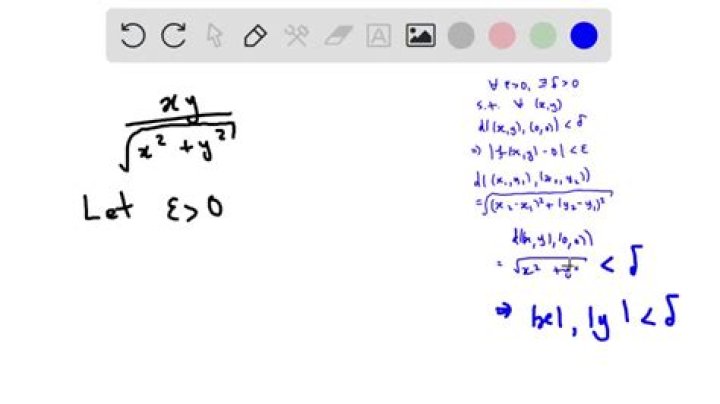
Graph for sqrt(x) from WolframAlpha:
This is how I solved the exercise:
For simplicity, I choose to disregard the negative result of $\pm\sqrt{x}$. Since we are looking at limits for $x \to 0$, both results will converge at the same point, and will thus have the same limits.
$\sqrt{x}$ = $0$ for $x = 0$.
$\sqrt{x}$ is a positive real number for all $x > 0$.
$\displaystyle \lim_{x \to 0^+} \sqrt{x} = \sqrt{+0} = 0$$\sqrt{x}$ is a complex number for all $x < 0$.
$\displaystyle \lim_{x \to 0^-} \sqrt{x} = \sqrt{-0} = 0 \times \sqrt{-1} = 0i = 0$
The solution in the book, however, does not agree that there exists a limit for $x \to 0-$.
I guess there are three questions in this post, although some of them probably overlaps:
- Does $\sqrt{x}$ have a limit for $x \to 0$?
- Are square root functions defined to have a range of only real numbers, unless specified otherwise?
- Is $\sqrt{x}$ continuous for $-\infty < x < \infty$?
WolframAlpha says the limit for x=0 is 0: limit (x to 0) sqrt(x)
And also that both the positive and negative limits are 0: limit (x to 0-) sqrt(x)
If my logic is flawed, please correct me.
$\endgroup$ 32 Answers
$\begingroup$There is undeniably a right-hand limit. You have $\sqrt{x}\to 0$ as $x\downarrow 0$. In fact, since $\sqrt{0} = 0$, you know the square root function is right continuous at zero.
However, there is no possibility limit as $x\to 0-$, since the domain of this function is $[0,\infty)$. To discuss the left-hand limit of a function at a point $a$, the function must be defined in some interval $(q, a)$, where $q < a$.
The square root function is continuous on its domain. Since it is not defined on $(-\infty, 0)$, it is often informally said that it has a "limit at zero."
$\endgroup$ 2 $\begingroup$The answers to your questions depend on whether you are working with $\mathbb{R_{\geq 0}}$ or $\mathbb{R}$ as your domain. $\sqrt{x}$ is really not the same function in these two cases.
With a domain of $\mathbb{R_{\geq 0}}$:
- Clearly $\lim_{x \to 0^+} \sqrt{x} = 0$. However $\lim_{x \to 0^-} \sqrt{x}$ is not defined for negative numbers in this case, so $\lim_{x \to 0^-} \sqrt{x}$ is undefined.
- If your course is on real analysis, they most likely assume that the domain is $\mathbb{R_{\geq 0}}$. However, this could depend very much on the context. If you are unsure what your course's convention is, you should consult a teaching assistant.
- In this case, $\sqrt{x}$ is not continuous on $\mathbb{R}$, since it is not even defined everywhere.
With a domain of $\mathbb{R}$:
- As your plot shows you, both the real and the imaginary parts tend to 0, and so $\sqrt{x}$ tends to 0.
- See above.
- Once again, your plot shows you that both the real and imaginary parts are continuous functions over $\mathbb{R}$, and so $\sqrt{x}$ is continuous over $\mathbb{R}$.
Note that there is an even more general case, where the domain is $\mathbb{C}$. This is where things get very strange.
$\endgroup$ 0