Do Irrational Conjugates always come in pairs?
Please forgive me for any mistakes while asking this question. While applying the quadratic formula to find out the roots, or using any other methods to find the roots, I observe that the roots of the equation $y=x^2-3$ are $\sqrt{3}$ and $-\sqrt{3}$. These roots evaluate to be irrational, and the roots always happen to come in irrational conjugates. If I do this with any other polynomial equation, the irrational solutions almost always come in conjugates. However, I have found a few exceptions to this, and I do not know why this occurs. Take the equation $-x^3-2x^2+2$, where two of the solutions are complex solutions. After applying long division, why do I get the other answer to be an irrational solution? I thought that if there is one irrational solution, surely there must be another, but this is not the case in the equation provided. Why is this so?
$\endgroup$ 64 Answers
$\begingroup$The product of all the roots of the polynomial is exactly the constant term of the polynomial, up to a factor of $\pm 1$. So if your polynomial has all integer coefficients and at least one root not in $\mathbb{Q}$, then it has to have at least one other root not in $\mathbb{Q}$ - otherwise, we would multiply all the roots and have an irrational number equal to a rational one.
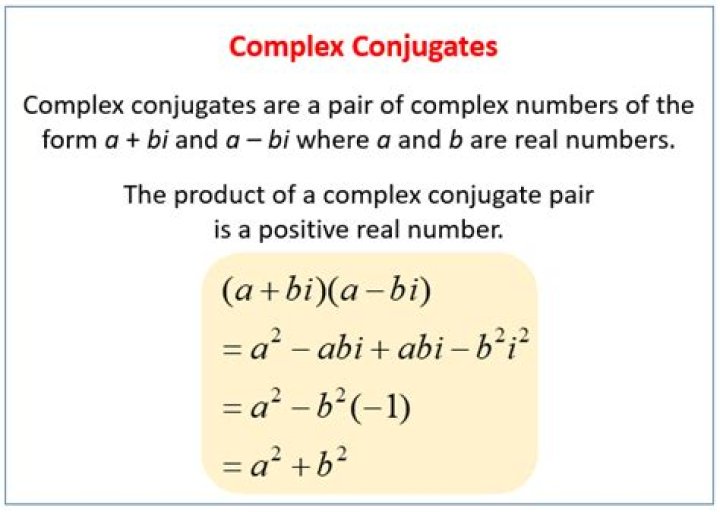
These roots can, of course, be complex; in this case, either the real part or the imaginary part must be irrational. This is exactly what you're observing in this case. There is one real, irrational root and a pair of complex (conjugate) roots that have irrational real and imaginary parts.
$\endgroup$ 1 $\begingroup$I think you are confusing irrational solutions with complex solutions.
Irrational solutions need not come in pairs. The equation $$ x^3 - 2 = 0 $$ has three roots. One is the irrational real number $\alpha = 2^{1/3}$.The other two are the complex conjugate pair $$ \alpha \left(\frac{-1 \pm i \sqrt{3}}{2} \right). $$
The complex roots of a polynomial with real coefficients always come in conjugate pairs.
$\endgroup$ 2 $\begingroup$Here is a real polynomial with two roots: one rational and one irrational: $$ P(x) = (x+3)(x+\sqrt{3}) $$ They are not irrational conjugates, naturally.
$\endgroup$ $\begingroup$The Irrational Conjugates Theorem is not false, but is often taught (and given in textbooks) without enough emphasis on a crucial point. It applies only if one root is a rational number plus the irrational SQUARE ROOT of a rational number. If the first irrational root you find is, say, the cube root of 3, the irrational part is not the square root of a rational number and the theorem does not apply. As an algebra teacher, I butted my head against this myself for some time until I realized what was going on.
$\endgroup$