Dividing functions with double fractions
Let $g(x)=x+5$ and $h(x)=\frac{4}{x}$. Find the domain and simplify the following expression
$$(\frac{g}{h})(x)$$
I'm confused by the double fraction, please help.
$\endgroup$3 Answers
$\begingroup$the domain of the first one is $\mathbb{R}$ and the second is $\mathbb{R}-\{ 0 \}$ the domain of the devision is their intersection difference zeros of the second one(in this cae $h$ has no zero) i.e. the domain of the new function is $\mathbb{R}-\{ 0 \}$ and the function becomes $$(\frac{g}{h})(x)=\frac {g(x)}{h(x)}=\frac {x+5}{\frac 4x}=\frac{x(x+5)}{4} $$
$\endgroup$ $\begingroup$$(g/h)(x)=\frac {g(x)}{h(x)}=\frac {x+5}{\frac 4x}$ As $x=0$ is not allowed, you can multiply by $1=\frac xx$ to clear the fraction from the denominator.
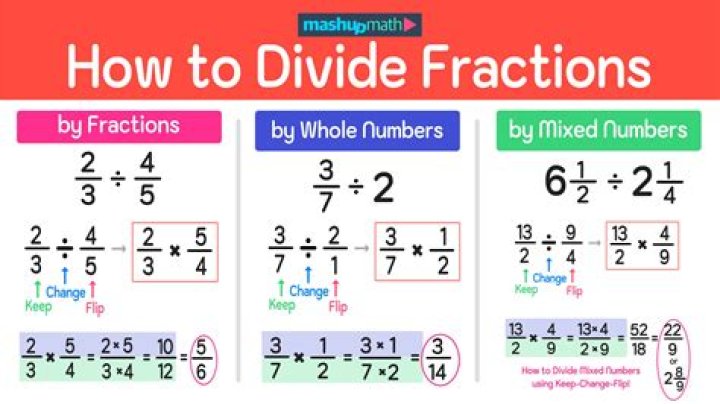
$\endgroup$ $\begingroup$From one of the properties of functions, $ (\frac{g}{h})(x) = \frac{g(x)}{h(x)} $. Thus $$ \frac{g(x)}{h(x)} = \frac{x + 5}{\frac{4}{x}} = (x + 5) \div \frac{4}{x} $$
Now dividing a function by a fraction has the same effect as multiplying a function by that fraction's reciprocal. So, $$ (x + 5) \div \frac{4}{x} = (x + 5) \times \frac{x}{4} $$ and $$ (x + 5) \times \frac{x}{4} = \frac{(x+5)(x)}{4} = \frac{x^2 + 5x}{4} = \frac{x^2}{4} + \frac{5}{4}x $$
Thus $$ (\frac{g}{h})(x) = \frac{x^2}{4} + \frac{5}{4}x $$ and its domain (the values for $ x $ for which the function is defined) consists of the entire set of real numbers $ \mathbb{R} $ excluding $ x = 0 $ (for which $ h(x) $ is undefined at that value of $ x $).
$\endgroup$