Difference between function and equation
What is the precise difference between function and equation ? In which case will it be wrong if used( common mistakes )? Also will the Venn diagram overlap if I were to draw one ? Any help and discussions will be appreciated .
$\endgroup$ 14 Answers
$\begingroup$A function is a transformation or mapping of one thing into another thing. It might be written as a rule (e.g. "Take the input and square it"), as a formula ("e.g. $f(x) = x^2$ or $x \mapsto x^2$), as a set of ordered pairs (e.g. $\left\{(1, 1), (2, 4), (3, 9), \ldots\right\}$, or any other way of showing how the output relates to the input. The function doesn't have to use numbers, either - a function could take two words and return their letters interlaced (so f(cat, dog) = cdaotg) or it could tell you what day of the week a given date falls on, or the post code/zip code of a given geographical location.
[In very formal terms, a function is a set of input-output pairs that follows a few particular rules.]
An equation is a declaration that two things are equal to each other. For example, $2^2 = 4$ is an equation stating that the square of 2 is 4. An equation may include variables of unknown value, and it may be true for all, some or none of the possible values of those variables. For example, $x^2 = 4$ is an equation that is true when $x = \pm 2$, and false for other values of $x$, while $x^2 = -4$ is an equation that is false for all real values of $x$.
What may be confusing you is that we often use equations to declare a relationship between two variables, often in the form of a function or formula. For example, $y = x^2$ is an equation stating that the value of $y$ is determined by the value of $x$ via the function $x^2$.
$\endgroup$ 6 $\begingroup$I think we also tend to muddy the semantic waters when we insist on referring to $f(x) = x^2$ (for instance) as a function. It's not: It's an equation. The function in this case is given by the expression $x^2$, so in that way we can say that expressions are functions. In this example, $f$ is the name of the function, $x$ is the input of the function,and $x^2$ is the expression which is the output, i.e., the function $f(x)$ itself.
$\endgroup$ 3 $\begingroup$It might be useful to introduce the term formula at this point.
Functions have arguments, i.e., values to be input into a formula. Equations do not have arguments to be input into a formula.
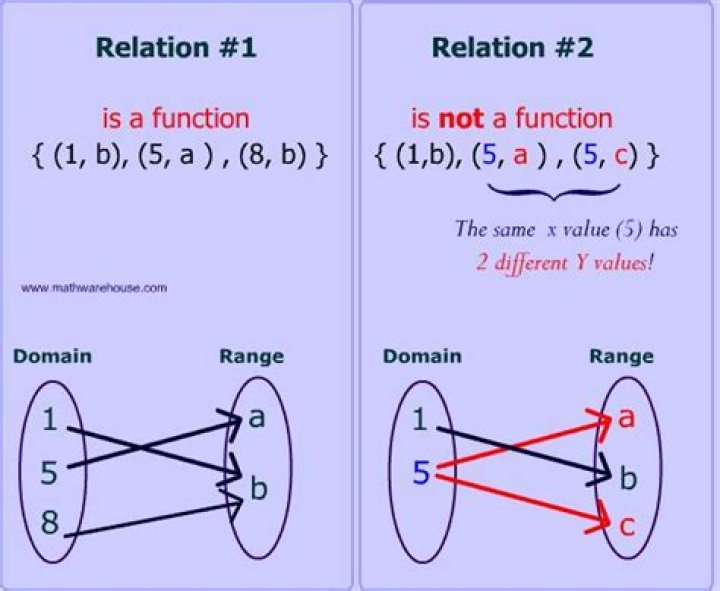
$\endgroup$ $\begingroup$A function $f(x):D\to C$ must satisfy $\forall x\in C \ \text{where f is defined in this point $x$},\ \exists!\ f(x)\in D$; i.e. every point in the domain of $f$ for which $f$ is still defined may have only one image, which is a point on the line (a point in the codomain). Not to confuse with surjectivity. For example, $f:\mathbb{R}\to\mathbb{R}$ with $f(x)=\sin(x)$ is non-surjective for there is no $x\in \mathbb{R}$ such that $f(x)=2$. But the $\sin(x)$ is a function because there's no $x$-value with a multiple $f(x)$-value.
An equation can be every equalty: a function is an equality, a differential equation is an equality.
E.g. $x=y^2$ is an equation, but not a function if we view it with x in the domain and y in the codomain. For instance, $x=1$ has $y=1$ and $y=-1$ as solution (point in domain with two different images). Hence, not a function in the $(x,y)$-plane.