Determine the value of h such that the matrix is the augmented matrix of a consistent linear system.
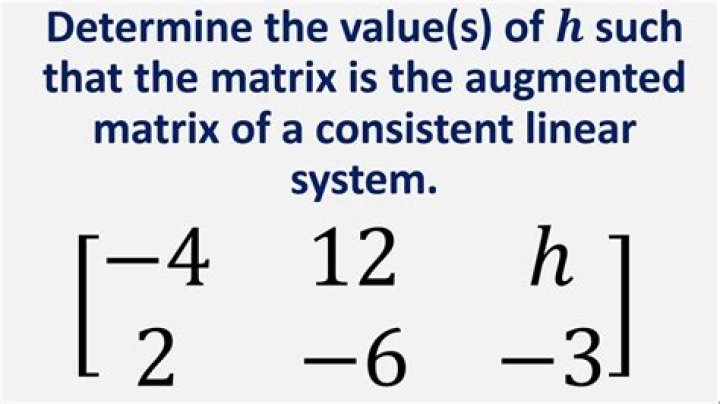
Determine the value of h such that the matrix is the augmented matrix of a consistent linear system. $$ \begin{bmatrix} 1 && h && 4 \\ 3 && 6 && 8 \end{bmatrix} $$
I'm entirely unsure how to go about solving this.
This how far I got:
$$ \sim\begin{bmatrix} 1 && h && 4 \\ 0 && (6-3h) && -4 \end{bmatrix} R_2' = R_2-3R_1 $$
$$ 6-3h=-4 \\ 6+4=3h \\ 10=3h \\ h=3/10 \text{ ?} $$
New progress
$$ \sim\begin{bmatrix} 3 && 6 && 8 \\ 1 && h && 4 \end{bmatrix} R_1 \leftarrow\rightarrow R_2 $$
$$ \sim\begin{bmatrix} 3 && 6 && 8 \\ 0 && (h-2) && 4/3 \end{bmatrix} R_2' = - \frac13 R_1 $$
$$ \sim\begin{bmatrix} 3 && 6 && 8 \\ 0 && 3(h-2) && 4 \end{bmatrix} R_2' = 3R_2 $$
$$ \sim\begin{bmatrix} 3 && 6 && 8 \\ \\ 0 && 1 && \frac{4}{3(h-2)} \end{bmatrix} R_2' = R_2 \div 3(h-2) $$
$$ \sim\begin{bmatrix} -3 && 0 && z \\ \\ 0 && 1 && \frac{4}{3(h-2)} \end{bmatrix} R_1' = 6R_2 - R_1 \\ z = -8 + \frac{24}{3(h-2)} = \frac{-32(h-2) + 24}{3(h-2)} $$
$$ \sim\begin{bmatrix} 1 && 0 && z \\ \\ 0 && 1 && \frac{4}{3(h-2)} \end{bmatrix} R_1' = -\frac13 R_1 \\ z = - \frac{-32(h-2) + 24}{(h-2)} $$
$\endgroup$ 32 Answers
$\begingroup$Do these row operations:
- Swap $R_1$ and $R_2$
- $R_2 \rightarrow -R_1/3 + R_2$
- $3R_2$
- Divide $R_2/(3(h-2))$
- $R_1 \rightarrow 6R_2 - R_1$
- Divide $R_1/3$
This should provide the value of $h$ that makes the system inconsistent.
Spoiler - Do Not Peek
$\begin{bmatrix} 1 && 0 && \dfrac{8(h-3)}{3(h-2)} \\ 0 && 1 && \dfrac{4}{3(h-2)}\end{bmatrix}$
Notes:
- Sometimes you can also look at the determinant of the system, in this case it is $6-3h$ (what value of $h$ would make this inconsistent).
- You could have also reduced and solved the system as another approach. You get $y = \dfrac{4}{3(2-h)}$ and can substitute back.
- There are other approaches.
Look at the matrix in the first two columns. It is invertible iff $h\not=2$; this is indicated by computing the determinant.
$\endgroup$