Determine if vectors are linearly independent
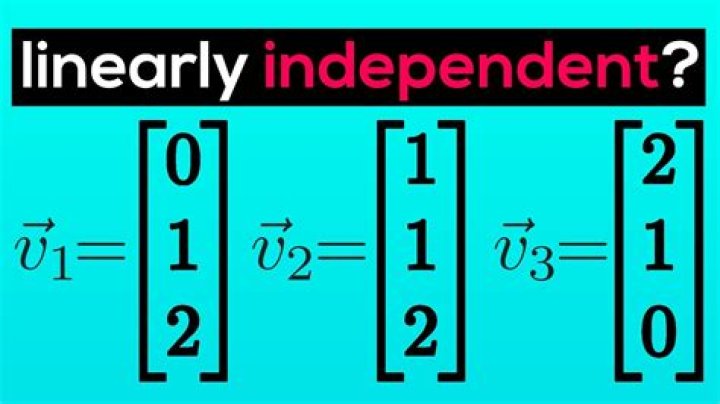
Determine if the following set of vectors is linearly independent:
$$\left[\begin{array}{r}2\\2\\0\end{array}\right],\left[\begin{array}{r}1\\-1\\1\end{array}\right],\left[\begin{array}{r}4\\2\\-2\end{array}\right]$$
I've done the following system of equations, and I think I did it right... It's been such a long time since I did this sort of thing...
Assume the following: \begin{equation*} a\left[\begin{array}{r}2\\2\\0\end{array}\right]+b\left[\begin{array}{r}1\\-1\\1\end{array}\right]+c\left[\begin{array}{r}4\\2\\-2\end{array}\right]=\left[\begin{array}{r}0\\0\\0\end{array}\right] \end{equation*} Determine if $a=b=c=0$: \begin{align} 2a+b+4c&=0&&(1)\\ 2a-b+2c&=0&&(2)\\ b-2c&=0&&(3) \end{align} Subtract $(2)$ from $(1)$: \begin{align} b+c&=0&&(4)\\ b-2c&=0&&(5) \end{align} Substitute $(5)$ into $(4)$, we get $c=0$.
So now what do I do with this fact? I'm tempted to say that only $c=0$, and $a$ and $b$ can be something else, but I don't trust that my intuition is right.
$\endgroup$ 54 Answers
$\begingroup$You just stopped too early:
Since you have 3 varibles with 3 equations, you can simply obtain $a,b,c$ by substituting $c = 0$ back into the two equations:
From equation $(3)$, $c = 0 \implies b = 0$.
With $b = 0, c = 0$ substituted into equation $(1)$ or $(2)$, $b = c = 0 \implies a = 0$.
So in the end, since
$$\begin{equation*} a\left[\begin{array}{r}2\\2\\0\end{array}\right]+b\left[\begin{array}{r}1\\-1\\1\end{array}\right]+c\left[\begin{array}{r}4\\2\\-2\end{array}\right]=\left[\begin{array}{r}0\\0\\0\end{array}\right] \end{equation*}\implies a = b = c = 0, $$ the vectors are linearly independent, based on the definition(shown below).
The list of vectors is said to be linearly independent if the only $c_1,...,c_n$ solving the equation $0=c_1v_1+...+c_nv_n$ are $c_1=c_2=...=c_n=0.$
You could have, similarly, constructed a $3\times 3$ matrix $M$ with the three given vectors as its columns, and computed the determinant of $M$. Why would this help? Because we know that if $\det M \neq 0$, the given vectors are linearly independent. (However, this method applies only when the number of vectors is equal to the dimension of the Euclidean space.)
$$M = \begin{bmatrix} 2 & 1 & 4 \\ 2 & -1 & 2 \\ 0 & 1 & -2 \end{bmatrix}$$
$$\det M = 12 \neq 0 \implies\;\text{linear independence of the columns}.$$
$\endgroup$ 0 $\begingroup$you can take the vectors to form a matrix and check its determinant. If the determinant is non zero, then the vectors are linearly independent. Otherwise, they are linearly dependent.
$\endgroup$ $\begingroup$just as simple,make these three vectors to be a matrix,as follows:
2 2 0
1 -1 1
4 2 -2
and then change it to its row-echelon form,you can get the rank of this matrix. its rank is 3,so the three vectors are linearly independent.
$\endgroup$ 0 $\begingroup$Firstly, you are to arrange the vectors in a matrix form the reduce them to a row-reduced echelon form. (If the last row becomes all zeros then it is linearly dependent, but if the last row isn't all zeros then it is linearly independent). Let's get to it now.
Arranging the vectors in matrx form we have ; 2 2 0 1 -1 1 4 2 -2
After the first reduction we get; 2 2 0 0 2 0 0 2 -2
Then, after the third reduction which is the last we have; 2 2 0 0 2 0 0 0 -2
Since the last row isn't equal to all zeros after the reduction then the vectors are linearly independent. You're welcome xx
$\endgroup$ 2