Determine if the series converges absolutely, conditionally, or diverges.
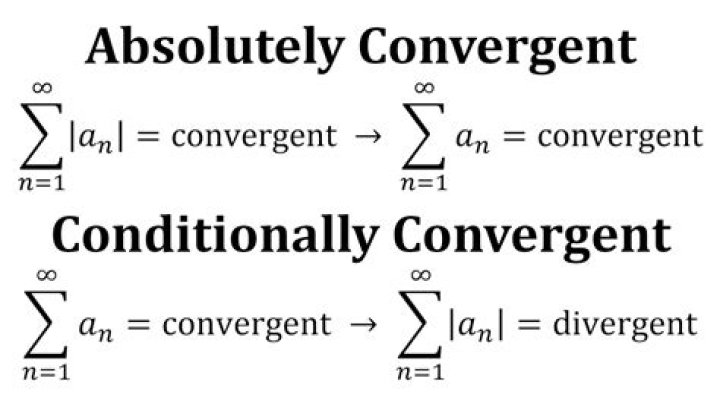
Determine if the series converges absolutely, converges conditionally, or diverges. Find the exact value for the sum of the convergent series.$$1-\frac{1}{5} - \frac{1}{5^2} + \frac{1}{5^3} - \frac{1}{5^4} - \frac{1}{5^5} + \frac{1}{5^6} - \frac{1}{5^7} - \frac{1}{5^8} ...$$I have no clue where to start. I tried using the comparison test comparing this series to the series to the series $\sum_{n=1}^{\infty}\frac{1}{n^2}= 2$ but that only tells me that this is a convergent series, not what value it converges to or if it is absolutely convergent or conditional convergent. Any advice and tips on how to solve this problem and these types of in general would be greatly appreciated. Thank you in advance :)
$\endgroup$ 21 Answer
$\begingroup$This converges absolutely if you compare with the geometric series with $r = 1/5$. More specifically, it is less than$$ \sum_{i \ge 0} (1/5)^i = \frac {1}{1-1/5} $$
$\endgroup$ 4