determine centre point of circle with 3 known factors
i'm trying to determine the centrepoint of a circle which passes through two known points (x,y). also, the radius of the circle that passes through those two points is known.
with these given factors, how would i be able to calculate the center point of the circle?
$\endgroup$ 14 Answers
$\begingroup$Suppose $A$ and $B$ are the given points and $r$ the given radius.
The centre of the circle is on the perpendicular bisector $a$ of the segment $AB$
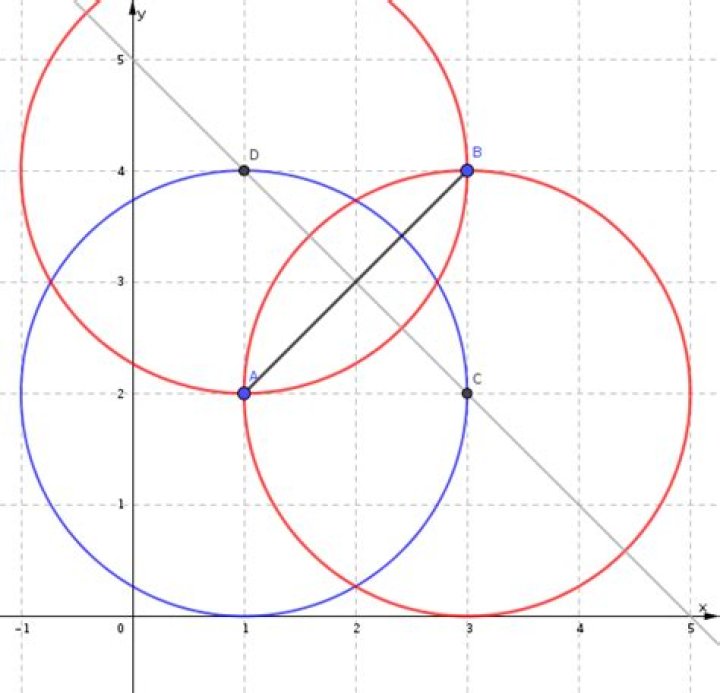
So I draw a circle with centre $A$ and radius $r$ which intersects $a$ in two points $C_1$ and $C_2$ which are the centres of the requested circles.
So there are two solutions, provided that $r> \dfrac{AB}{2}$.
If $r=\dfrac{AB}{2}$ there is only one solution: the circle having diameter $AB$
If $r< \dfrac{AB}{2}$ there are no solutions
Hope this can be useful
Edit
Suppose we have $A(1,2),\;B(3,4)$ and radius $r=2$
first write the perpendicular bisector $a$ that is the locus of the points $(x,y)$ such that $PA^2=PB^2$ $$(x-x_A)^2+(y-y_A)^2=(x-x_B)^2+(y-y_B)^2$$ plugging the data we get $a:x+y-5=0$
Now write the equation of the circle with centre $A$ and radius $r=2$
$(x-1)^2+(y-2)^2=4$
expand and get
$x^2+y^2-2 x-4 y+1=0$
Solve the system formed by the line $a$ and this last circle we have found
$ \left\{ \begin{array}{l} x^2+y^2-2x-4 y+1=0 \\ x+y-5=0 \\ \end{array} \right. $
Solutions are $C_1(1,\;4);\;C_2(3,\;2)$
so we can get the equations of the two circles
$$(x-1)^2+(y-4)^2=4;\;(x-3)^2+(y-2)^2=4$$ expanded they become $$x^2+y^2-2x-8y+13=0;\;x^2+y^2-6x-4y+9=0$$
You can also proceed with trigonometry. Call the distance between your two points $d$.
For any circle going through them, the following trigonometric equality holds: $$ r \sin \frac{\alpha}{2} = \frac{d}{2}$$ where $r$ is the radius, and $\alpha$ is the angle subtended by the arc though the two points, from the circle center. You know $r$ too, so $$\sin \frac{\alpha}{2} = \frac{d}{2r} $$ which allows to calculate $\alpha$.
By noting now that $r \cos \frac{\alpha}{2}$ is the distance from the mid-point of the chord to the center. Just erect a segment perpendicular to the chord (of course this can be done in two directions...), and of length $r \cos \frac{\alpha}{2}$, and you are on the centre.
The said distance (from the chord's midpoint to the centre) is of course also equal to $$\sqrt{r^2 - ( \frac{d}{2})^2} $$ maybe also useful.
$\endgroup$ 6 $\begingroup$Possibly a shorter way will be two first find the perpendicular bisector of the line segment joining the two points on the circle.
You know the length of the chord and radius. Using Pythagoras theorem you can find distance of center from chord.
Now use parametric equation of line to move this distance from centre of chord, along the perpendicular bisector.
You will essentially get two circles as the centre can lie on either side of the chord.
$\endgroup$ $\begingroup$Straightforward method
Let center point be $(a,b)$. Then,
distance of center from one known point = radius
distance of center from second known point = radius
Use distance formula ($=\sqrt{(x_1-x_2)^2-(y_1-y_2)^2}$) in the above calculation. This yields two equations with two unknowns ($a$ and $b$). Square both sides to get:
$$(a-x_1)^2+(b-y_1)^2=r...E1$$ $$(a-x_2)^2+(b-y_2)^2=r...E2$$
Easier method: realize that the center of the circle will lie on the perpendicular bisector of the line joining these two points. This should give you an easier equation to work with.
Obviously, further realize that there would be two circles satisfying the above conditions.
Diagram:
Notice how the known points AB have become a chord to the circle.
$\endgroup$ 6