Detecting that a fraction is a repeating decimal
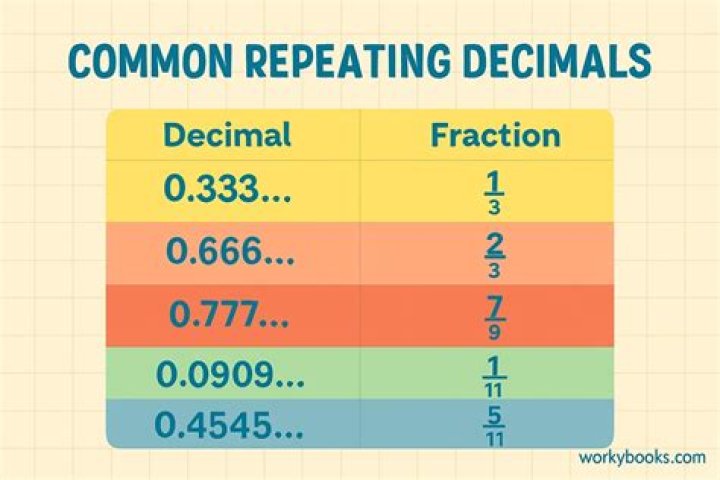
Given any fraction where both the numerator (N) and denominator (D) are both positive and are both whole numbers.
Without manually dividing N by D, is it possible to pre-determine if the resulting value represented in decimal would be a repeating value? (e.g. 44÷33 is 1.3333333333....)
I believe the value of N ÷ D will NOT be a repeating decimal if and only if D is any of the following
- D is equal to 1 OR
- D's prime factors only consist of 2's and/or 5's. (includes all multiples of 10)
Otherwise, if none of the two rules above hold true, then the positive whole numbers N and D will divide into repeating decimal.
Correct, or am I missing a case?
$\endgroup$ 53 Answers
$\begingroup$Correct.
From wikipedia:
$\endgroup$ 4 $\begingroup$A decimal representation written with a repeating final 0 is said to terminate before these zeros. Instead of "1.585000…" one simply writes "1.585". The decimal is also called a terminating decimal. Terminating decimals represent rational numbers of the form $k/(2^n5^m)$.
Decimals of fractions are always eventually periodic (eventually because e.g. $\frac1{300}=0.00\overline 3$, i.e. the period need not start immediately). Your exceptions only summarize the cases when the period consists of zeroes (and hence can be left out for convenience), e.g. $\frac18=0.125\overline0$. This will happen iff multiplication by a suitable power of ten makes the fraction an integer, i.e. if the denominator contains only 2's and 5's, as you correctly state.
$\endgroup$ 5 $\begingroup$There is a way to do this. You carry out the long division so as to produce remainder ratios and it either terminates or you get a ratio you've had before, in which case the expansion is repeating. Proof that every repeating decimal is rational
$\endgroup$