Deriving the sum-to-product identities
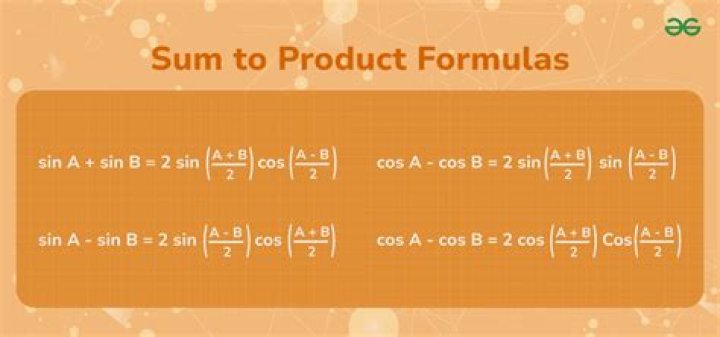
I've been asked by my textbook to derive the "sum-to-product" identities from the "product-to-sum" identities. I've attempted to to do this but i've met a dead end, and i'm quite confused.
Using the "product-to-sum" identity $\cos(\alpha)\cos(\beta)=\frac{1}{2}[\cos(\alpha-\beta)+\cos(\alpha+\beta)]$ to derive the "sum-to-product" identity $\cos(\alpha)+\cos(\beta)=2\cos(\frac{\alpha+\beta}{2})\cos(\frac{\alpha-\beta}{2})$:
I begin by rearranging the "product-to-sum" identity:
$\cos(\alpha)\cos(\beta)=\frac{1}{2}[\cos(\alpha-\beta)+\cos(\alpha+\beta)]$
$2\cos(\alpha)\cos(\beta)=\cos(\alpha-\beta)+\cos(\alpha+\beta)$
$\cos(\alpha-\beta)+\cos(\alpha+\beta)=2\cos(\alpha)\cos(\beta)$
From comparing the two identities:
The "product-to-sum" identity: $\cos(\alpha-\beta)+\cos(\alpha+\beta)=2\cos(\alpha)\cos(\beta)$
The "sum-to-product" identity: $\cos(\alpha)+\cos(\beta)=2\cos(\frac{\alpha+\beta}{2})\cos(\frac{\alpha-\beta}{2})$
By comparing the two functions it is apparent that:$\alpha=\frac{\alpha+\beta}{2}$, $\beta=\frac{\alpha-\beta}{2}$
This confuses me as I simplify to get: $\alpha=\beta$ and $3\beta=\alpha$, which sounds absurd..
Where do I go from here? Where have I went wrong?
$\endgroup$ 73 Answers
$\begingroup$I think it is more instructive to think like this: you want to transform $\cos x + \cos y$ into a product. Let: $$\left\{\begin{array}{l} x = a + b \\ y = a - b \end{array}\right.$$ Solving for $a$ and $b$ we get: $$\left\{\begin{array}{l} a = \frac{x + y }{2} \\ b = \frac{x - y}{2} \end{array} \right.$$
This way, we get: $$\begin{align} \cos x + \cos y &= \cos(a+b) + \cos(a - b) \\ &= \cos a~\cos b - \sin a~\sin b + \cos a~\cos b + \sin a~\sin b \\ &= 2\cos a~\cos b \\ &= 2\cos\left(\frac{x + y}{2}\right)\cos\left(\frac{x - y}{2}\right) \end{align}$$
This also works for $\sin x + \sin y$, $\sin x - \sin y$, $\cos x - \cos y$, etc.
$\endgroup$ 2 $\begingroup$You almost had the path to your proof when you made this connection between the two identities: $\alpha=\frac{\alpha+\beta}{2}$ and $\beta=\frac{\alpha-\beta}{2}$.
The only thing wrong with this, so far, is the use of the equality sign. You want to go from a statement about the product of functions of any two angles $\alpha$ and $\beta$ to a statement about the sum of functions of any two angles $\alpha$ and $\beta$--not necessarily the same $\alpha$ and $\beta$ (which is what these equations would represent).
To avoid confusion on this point, you can make up new names for the angles in one of the identities. For example, if you write the product-to-sum identity as $$\cos(\alpha-\beta)+\cos(\alpha+\beta)=2\cos(\alpha)\cos(\beta),$$ then write the sum-to-product identity as $$ \cos(\alpha')+\cos(\beta') = 2 \cos\left(\frac{\alpha'+\beta'}{2}\right) \cos\left(\frac{\alpha'-\beta'}{2}\right). $$ This is the same statement you were trying to prove, as long as it is true for all possible choices of $\alpha'$ and $\beta'$.
Now you can write $\alpha = \frac{\alpha'+\beta'}{2}$ and $\beta = \frac{\alpha'-\beta'}{2}$. Figure out how to write $\alpha'$ and $\beta'$ in terms of $\alpha$ and $\beta$, and this should give you a way to make substitutions into the product-to-sum identity that will produce something looking like the sum-to-product identity. We can also see from the substitutions for $\alpha$ and $\beta$ that you can find appropriate $\alpha$ and $\beta$ for any $\alpha'$ and $\beta'$, so the resulting identity is in fact true for any two angles, not just some pairs of angles.
$\endgroup$ 0 $\begingroup$The clearest way to do this is to note that both identities have the form $$\cos(\cdot) \cos(\cdot) = K (\cos (\cdot) + \cos (\cdot)),$$ where $K$ is a constant and $(\cdot)$ is some algebraic expression. So to get one from the other, we want to solve the relationship between the two variables.
For example, if we take the first identity (product-to-sum), then let $\alpha - \beta = x$, and $\alpha + \beta = y$. Then solve this system for $\alpha$ and $\beta$, and substitute this result into the LHS of the identity. Then multiply both sides of the equation by $2$. What do you see?
$\endgroup$