Derivative problem: No $x$ in equation and cubed roots
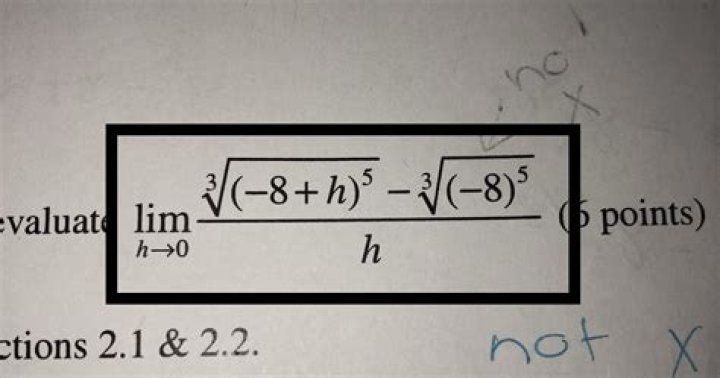
I am having trouble finding this answer to a derivative based problem. If anyone could walk me through this that would be great.
I am aware of all of the basics when it comes to derivatives.
When a problem contains $\dfrac{1}{h}(f(x+h)-f(x))$ I know that secluding the $f(x)$ from this equation helps in finding the derivative $f'(x)$.
However, I have never been faced with a problem like this where there is no $x$ present in the equation for $f(x)$.
Here is the problem:
2 Answers
$\begingroup$Consider $f(x) = \sqrt[3]{x^5} $.
Then $$f'(x) = \lim\limits_{h\to 0}\frac{f(x+h)-f(x)}{h} = \lim\limits_{h\to 0}\frac{\sqrt[3]{(x+h)^5}-\sqrt[3]{x^5}}{h} $$ Therefore, by substituting $x = -8$, we get that $$f'(-8) = \lim\limits_{h\to 0}\frac{\sqrt[3]{(-8+h)^5}-\sqrt[3]{(-8)^5}}{h} $$
That is, the derivative of $f(x)$ evaluated at $x=-8$.
$\endgroup$ 1 $\begingroup$The function is $\sqrt[3]{x^5}$ and the derivative is calculated at $x_0=-8$.
$\endgroup$