derivative of zero order bessel function of first kind
I want to know the derivative of the zero order bessel function of first kind ($J_0(x)$). and how it changes with $x$ and I also would like to know the roots of this function. could anyone help?
$\endgroup$ 11 Answer
$\begingroup$Let's remember that (as indicated by Did Abramowitz and Stegun is an excellent resource) :$$\tag{1}\operatorname{J}_{\nu}(z)=\sum_{k=0}^\infty \frac {\left(-1\right)^k\left(\frac z2\right)^{2k+\nu}}{\Gamma(k+\nu+1)k!}$$so that $$\tag{2}\operatorname{J}_0(z)=\sum_{k=0}^\infty \frac {\left(-1\right)^k\left(\frac z2\right)^{2k}}{\Gamma(k+1)k!}=\sum_{k=0}^\infty \frac {\left(-\frac {z^2}4\right)^k}{k!^2}$$and (with $j:=k-1$) :$$\tag{3}\operatorname{J}_0(z)'=\sum_{k=1}^\infty \frac {\left(-1\right)^k \,k\;\left(\frac z2\right)^{2k-1}}{k!\,k!}=-\sum_{j=0}^\infty \frac {\left(-1\right)^j \;\left(\frac z2\right)^{2j+1}}{\Gamma(j+2)j!}=-\operatorname{J}_1(z)$$
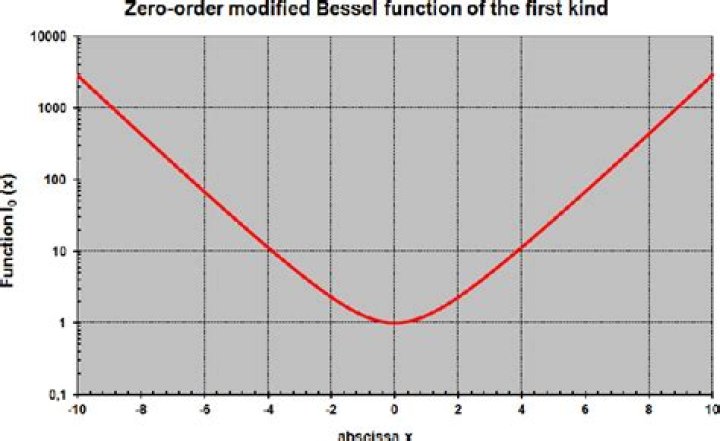
Concerning the zeros of $\operatorname{J}_0$ and $\operatorname{J}_1$ they are represented in A&S (some numerical values are shown in the table page 409) :
(source: math.sfu.ca)
Other useful resources are DLMF and Watson's famous books (freely available) :
$\endgroup$