Derivative of sinc function
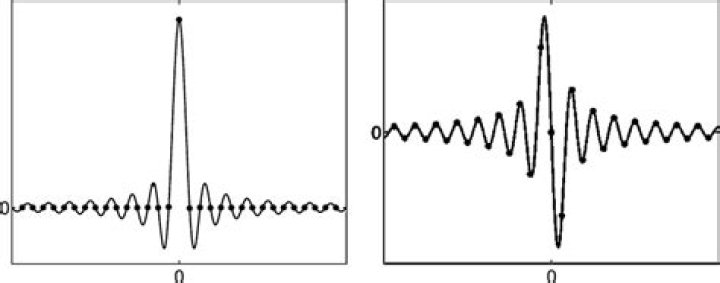
How to show that function $\left(\operatorname{sinc}{x}\right)^{n}=\left\{\dfrac{\sin\left(x\right)}{x}\right\}^{n}$ is infinitely differentiable at $0$?
$\endgroup$ 31 Answer
$\begingroup$Use the Taylor series expansion as mentioned in the comments to get: $$ \text{sinc}(x)=\frac{\sin x}{x}=\frac{-\sum_{k=0}^\infty { (-x)^{2k+1} \over {(2k+1)!}} }{x}=-\sum_{k=0}^\infty {(-1)^{2k+1}(x)^{2k} \over {(2k+1)!}}=1-{x^2 \over 3!}+{x^4 \over 5!}-\cdots, $$ which is infinitely often differentiable at $0$. You'll get $$ \frac{d^m}{dx^m} \text{sinc}(x) \Biggr|_{x=0}= \cases{ {(-1)^{m}\over(m+1)} & \text{if $m$ is even}\\ \phantom{case}&\\ \;\;\;\;\,\,0 & \text{if $m$ odd.} \\ } $$Because the product of two $C^∞$ functions is itself $C^∞$, we are done.
$\endgroup$