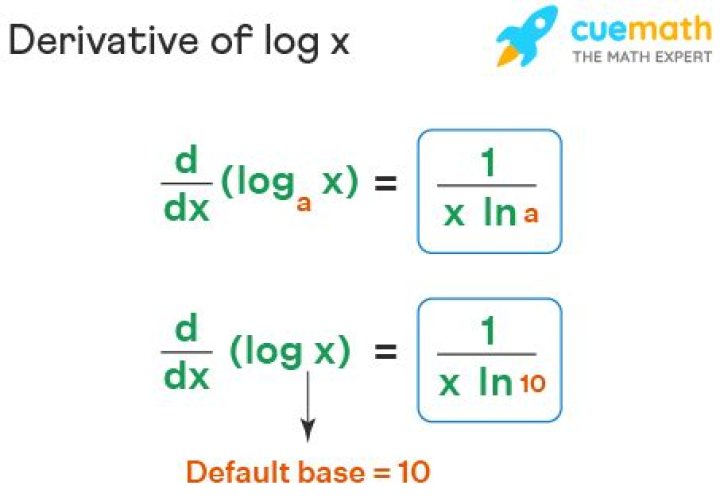
Derivative of $\log x$
If for the function $f$ there exists $g$ such that $g(f(x)) = x $, find the derivative of $g$. Then use this for computing the derivative of $f(x) = \log(x)$
I tried this:
$(g(f(x)))´ = g´(f(x))f´(x) = 1 $ then if $f(x) = \log(x)$ then $$(g(\log(x)))´ = g´(\log(x))(\log(x))´ = 1 $$ then $ f´(x) = (\log(x))´= \frac{1}{g´(\log(x))}$ but I'm stuck here. How can I conclude that the derivative of $\log(x)$ is $1/x$?
$\endgroup$ 72 Answers
$\begingroup$Let $f(x)=e^x$ and $g(x)=\log(x)$ its inverse, then $f(g(x))=x$ and: $$1=\frac{d}{dx}x=\frac{d}{dx}f(g(x))=f'(g(x))g'(x)=xg'(x)$$ where we used $f'(x)=f(x)$. Thus we must have $g'(x)=\frac{1}{x}$.
$\endgroup$ $\begingroup$You can proceed like this.D/dx =1
d/dx* e^{ln(x)}
Or e^{ln(x)}* d/dx*(lnx)=1
Or x *d/dx *ln(x)=1
d/dx *ln(x)=1/x
Hence proved.
$\endgroup$ 2