Del operator in one-dimensional domain.
Question Summary: If the del operator returns a vector, why when he is applied to a function with one-dimensional domain it returns a scalar function?
About the $\nabla$ operator, one can read in Wikipedia (Link Here)
Del, or nabla, is an operator used in mathematics, in particular, in vector calculus, as a vector differential operator, usually represented by the nabla symbol $\nabla$. When applied to a function defined on a one-dimensional domain, it denotes its standard derivative as defined in calculus.
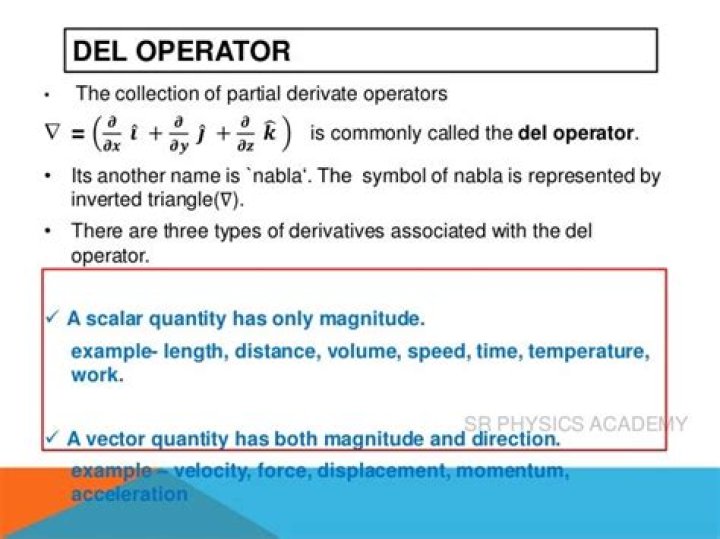
There is something here that i don't quite understand. The operator is defined as follows: $$\vec{\nabla} = \frac{\partial}{\partial x} \vec{i} + \frac{\partial}{\partial y}\vec{j} + \frac{\partial}{\partial z}\vec{k}$$ In the one-dimensional domain, one could expect: $$\vec{\nabla} = \frac{\partial}{\partial x}\vec{i}$$ And here is the problem. This is a vector. If i apply the operator to some $f:\mathbb{R}\rightarrow\mathbb{R}$, why it will (according to Wikipedia) return the standard derivative (scalar) and not a vector?
$\endgroup$ 21 Answer
$\begingroup$The reals are a vector space over themselves so you can consider any real number to be both a vector and a scalar. Since every real $x$ can be represented as $x\times 1$ it follows that $\{1\}=\{\vec{e_1}\}=\{ \vec{i}\}$ is a basis for the reals.
Then $\vec{\nabla} = \frac{\partial}{\partial x}\times 1 = \frac{d}{d x}$ which is to say that the gradient corresponds to ordinary differentiation.
So to answer your question, $\vec{\nabla}$ is taking a function and giving you a vector back, but for the reals, there is no distinction between vectors and scalars.
$\endgroup$ 0