Definition Unitary Group
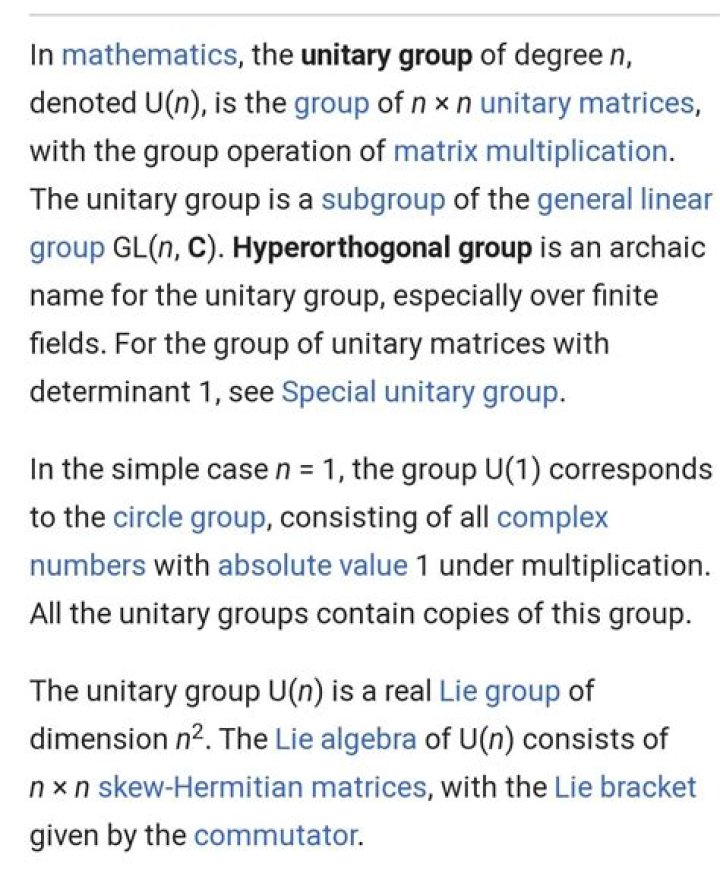
In understanding unitary group, i get confused because there are several definition of unitary group, first, in here: Sven Grützmacher
Let A matrix and define $A^{*}=\bar{A}^{T}$, Then we can define the unitary group,
$U(n)=\{M \in M_n \mathbb{(C)} | M^*M=I\}$
Then,
$U(p,q)=\{M \in M_n \mathbb{(C)} | M^*I_{p,q}M=I_{p,q} \}$
is the indefinite unitary group of signature $(p,q)$, where $p+q=n$.
But, in here: Order of finite unitary group
$U_n(q)= \{ M \in GL_n(F_{q^{2}}) | MM^*=I_n \}$
Also, from the above link and the book "The Subgroup Structure of The Finite Classical Groups", known the order of finite unitary group to be:
$q^{(n^2-n)/2} \prod _{k=1} ^{n} (q^k - (-1)^k)$.
So, if we take example of unitary group $U(3,5)$, according to the first link, the member of the group is $8\times8$ matrices? and according to the second link, the member of the group is $3\times3$ matrices over Finite Field in a of size 5^2? and when i used GAP, the order of U(3,5) is 126000, but with sage, is 228000. And, by manual counting, with $n=3$ and $q=5$, got 228000.
Would you give me clear definition of unitary group, definite and indefinite unitary group?
And, in paper "Unitals, projective planes and other combinatorial structures constructed from the unitary groups $U(3,q), q=3,4,5,7$", for q=5, which one is used? Because, in the paper, $U(3,5)$ have order of 126000, how they get it? only using GAP? how about the manual?
note that: i have not studied lie group yet.
$\endgroup$ 02 Answers
$\begingroup$Your first reference agrees with your second, defining $U(n) = \{M \in M_{n}(\mathbb{C}) \ | \ M^{*}M = I\}$. If there is any indication that you are working in a finite setting, $U(3,5)$ will denote what you have labeled as $U_{3}(5)$: $3 \times 3$ matrices over a finite field of order $5^{2}$. (Note that all of the groups of complex matrices will have infinite order.)
I'm not sure about why GAP gives that order for the group. Are you asking GAP for the order of $GU(3,5)$, $SU(3,5)$ or $PSU(3,5)$?
126,000 is the order for the group $PSU(3,5)$ (this is the subgroup of $U(3,5)$ of matrices with determinant 1, modded out by the kernel of the action of this group on the points of the projective plane of order 5, $\mathrm{PG}(2,5)$). Given the nature of the article, it makes sense that they would be dealing with the projective group.
$\endgroup$ 4 $\begingroup$It's been a week ago i've found the answer. In case of other get the same problem with me, i'll write the answer.
Let $A$ be a matrix and define $A^{*}=\bar{A}^{T}$. Then
$U(n)=\{M \in M_n \mathbb{(C)} | M^*M=I\}$
is unitary group and
$U(p,q)=\{M \in M_n \mathbb{(C)} | M^*I_{p,q}M=I_{p,q} \}$
is the indefinite unitary group of signature $(p,q)$, where $p+q=n$.
Since $p+q=n$, we can write it as $U(n,0)$. But instead of using notation $U(n,0)$, we write $U(n)$.
In case of finite field $F_{q^2}$, then
$U_n(q)= \{ M \in GL_n(F_{q^{2}}) | MM^*=I_n \}$.
For the order of unitary group, from the book "The Subgroup Structure of The Finite Classical Groups", we know:
order of unitary group given by $|U_{n}(q)|=q^{(n^2-n)/2} \prod _{k=1} ^{n} (q^k - (-1)^k)$.
and from the lecture note of classical group by Peter J. Cameron, we know:
order of special unitary group given by $|SU_{n}(q)|=|U_{n}(q)|/(q+1)$ and
order of projective special unitary group given by $PSU_{n}(q)=|SU_{n}(q)|/(n,q+1)$.
So, in paper "Unitals, projective planes and other combinatorial structures constructed from the unitary groups $U(3,q),q=3,4,5,7$". For $q=5$, that is $U(3,5)$ in the paper have order of $126000$, since the paper used projective special unitary group and the matrices is $3\times3$ matrix. Also now, the order is all syncrhonized, even using SAGE, GAP or manual counting. Thank you for viewing my question and i hope feedback and correction for the answer.
$\endgroup$