Definition of subset
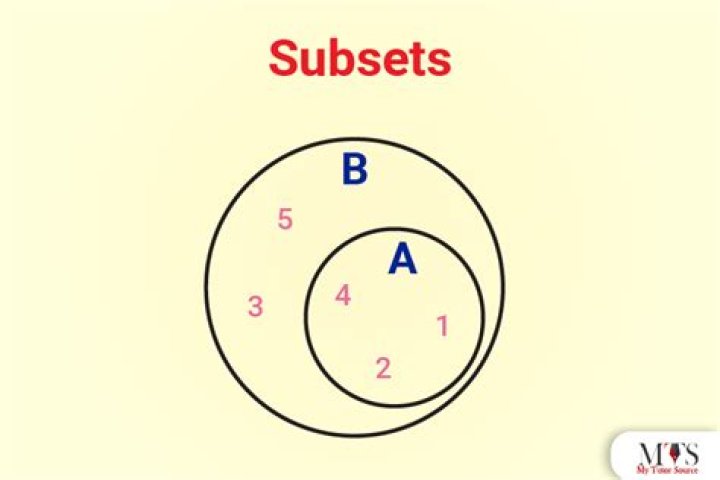
I am new to set theory, and even though I grasp the concept, I am having trouble with the formal definitions, specially with the subset one. The statement $A\subseteq B$ can be written as $\forall x(x\in A\rightarrow x\in B)$. Now, let $A = \left\{1, 2\right\}$ and $B = \left\{3, 4\right\}$ and $x=5$. Then, both $x\in A$ and $x\in B$ will be false, and, therefore, make the conditional true, which would make $x$ be part of the subset $A$ of $B$, but it is not. What am I getting wrong?
$\endgroup$ 14 Answers
$\begingroup$Making the conditional true does not make $x$ part of the subset $A$. The conditional is not defining membership in the set $A$. It is defining the condition for $A \subseteq B$. The condition says that each element $x$ must satisfy $x \in A \to x \in B$. You've verified the condition for a single element $x=5$, which is fine. But that doesn't mean that 5 is in $A$.
$\endgroup$ 2 $\begingroup$The fact that $5 \in \{1, 2\} \to 5 \in \{3, 4\}$ is true is (a little bit of) evidence to support the claim that $\{1, 2\} \subseteq \{3, 4\}$ (i.e., that $x \in \{1, 2 \}$ implies that $x \in \{3, 4\}$ for every $x$), but it doesn't imply that $5 \in \{1, 2\}$.
$\endgroup$ $\begingroup$You messed up "$\forall$" with "$\exists$". Subset definition use first.
$\endgroup$ $\begingroup$To avoid this case, you can take the following definition :
We say that the set $ A $ is a subset of the set $ B $ if and only if$$(\forall x\in A)\;\; x\in B$$
There will be no problem with $ x=5 $ since $ 5\notin A$.
$\endgroup$