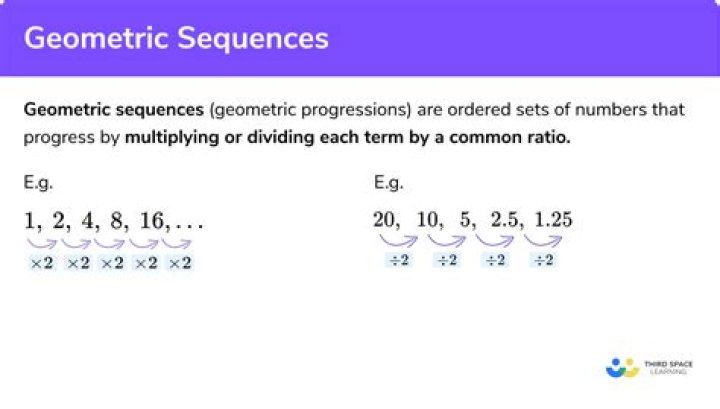
Definition of a geometric sequence
Is the sequence $0, 0, 0, 0 ...$ geometric? If so how would you define it? In order to define a geometric sequence you need the first term, and the ratio of terms. In this case you could have:
$a = 0$
$r = k$ for some $k \in \mathbb{R}$
Is this still geometric, even though a single unique definition doesn't exist (a non variable $r$)?
EDIT: This is an interesting debate. But you could also say that $0, 0, 0, 0 ...$ is an arithmetic sequence. So to all who are saying that it is geometric, can a sequence be both geometric and arithmetic?
$\endgroup$ 56 Answers
$\begingroup$Ultimately it will depend on what you consider the definition of a geometric series, as you can see by the other answers here. If the definition relies on calculating a common ratio $r = a_{k+1}/a_k$, then you will run into division by $0$.
You can avoid that problem by saying that a geometric sequence is one whose terms obey the property $a_ka_{k+2} = a_{k+1}^2$. Another way is to define the sequence as $a_k = cr^k$.
Personally, I would say that the sequence $0,0,0,\ldots$ is a geometric sequence in the same way that a point is a circle of radius $0$.
$\endgroup$ 12 $\begingroup$Just to play devil's advocate, here are some theorems we lose if we allow a sequence that ends in zeroes to be geometric:
A geometric sequence converges if and only if the common factor is in $(-1,1]$. (Counterexample: $0\cdot 2^{n-1}$ does converge).
A geometric sequence has a sum if and only if the common factor is numerically less than $1$. (Counterexample: $0\cdot 2^{n-1}$ does have a sum).
If $(a_n)$ and $(b_n)$ are geometric sequences and for some $i$ we have both $a_i=b_i$ and $a_{i+1}=b_{i+1}$, then $a_i=b_i$ for all $i$. (Counterexample: $0,0,0,\ldots$ versus $1,0,0,\ldots$).
Pragmatically it is probably most useful to exclude these sequences from being "geometric" such that the statements of the general properties can be kept simple. If we need to apply the theorems in a situation where the sequence might be degenerate, it is usually very simple to handle degenerate cases by ad-hoc methods.
$\endgroup$ 9 $\begingroup$It depends on the exact definition, using @Atvin definition, it is not geometric. Using an alternate definition, e.g. "a geometric sequence has the form $a_n = c r^{n-1},$ where $c,r$ are constants." Taking $c=0$ generates your sequence.
$\endgroup$ 6 $\begingroup$Using the definition: $\frac{ a_{n+1}}{a_n} = q$
It can't be a geometric series, since by definition it comes, that $\frac{ a_{n+1}}{a_n} = q$(for every $n \in \mathbb{N}$), where $q$ quotient is fixed, but in that case, you have $\frac00$, which leads to divising with $0$, and you can't do that. :)
$\endgroup$ 6 $\begingroup$We could also define a geometric sequence as any sequence such that each term ,after the first term, is the geometric mean of its successor and predecessor.
In which case, the sequence given would satisfy this definition.
I suppose it comes down to which definition we are using.
$\endgroup$ $\begingroup$As others have noted, it all depends on how precisely one defines the term geometric sequence. One can define anything one likes; for instance Wikipedia gives the definition that the general term at position $n$ (starting from $0$) should be of the form $ar^n$ with the rather ridiculous condition that $r\neq0$ though $a$ is unconstrained; that would make $0,0,\ldots$ into a geometric series of undetermined ratio $r\neq0$ (taking $a=0$), but $1,0,0,\ldots$ would not be a geometric series (here the ratio would clearly have to be $0$, but that was forbidden).
Part of the problem here is that one tries to define the unqualified notion "geometric progression" (or sequence), while in practice one most often deals with geometric progressions of specified ratio $r$ (in which case the general term is simply $ar^n$ where $a$ is the initial term); this shifts the focus from generating a geometric progression (which really never poses any problem) to recognising a given sequence as being geometric (this leads to considering ratios of successive terms, which is problematic if they are $0$; it still does not explain why one should forbid $r$ to be $0$, but not $a$).
To take some distance from the rather uninspiring "I found a source that says this" approach, let me view geometric sequences as an instance of anther notion, that of eigenvector. In the vector space of infinite sequences, the geometric sequences with ratio $r$ are precisely the eigenvectors of the "guillotine operator", which removes the initial term of a sequence and shifts the other terms to fill its place, for the eigenvalue$~r$. From this perspective, one sees why the zero sequence should have a special status; normally the zero vector is explicitly forbidden as eigenvector (because it would be so for any value of$~\lambda$, whether or not it is an eigenvalue), although it is included in any eigenspace. For the exact same reason allowing the zero sequence as a geometric sequence is somewhat problematic (no unique ratio can be determined for it) but it is OK (in fact necessary) to include the zero sequence in the subspace of geometric sequences with given ratio$~r$.
Note that viewing geometric sequences as eigenvectors is quite natural; they are used in this role when solving linear recurrence relations with constant coefficients.
$\endgroup$