Defining the equation of an ellipse in the complex plane
Usually the equation for an ellipse in the complex plane is defined as $\lvert z-a\rvert + \lvert z-b\rvert = c$ where $c>\lvert a-b\rvert$. If we start with a real ellipse, can we define it in the manner below?
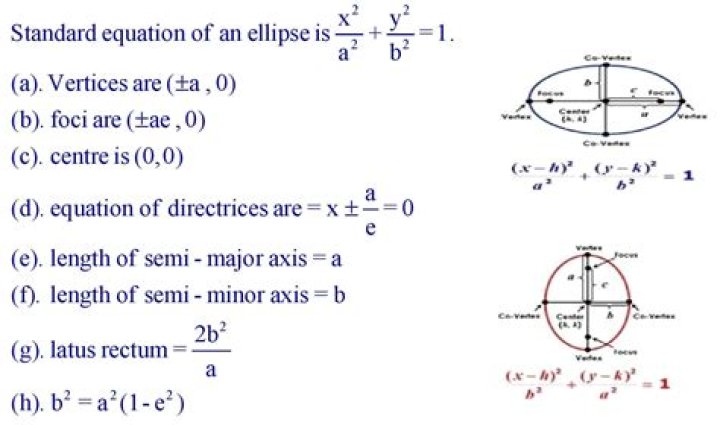
For $x,y,h,k,a,b\in\mathbb{R}$ such that $a,b\neq 0$, we define a real ellipse as $$ \frac{(x - h)^2}{a^2} + \frac{(y - k)^2}{b^2} = 1. $$ Let $z = \frac{x}{a} + i\frac{y}{b}$ and $z_0 = \frac{h}{a} + i\frac{k}{b}$. If we expand the equation for an ellipse, we have $$ \frac{x^2}{a^2} + \frac{y^2}{b^2} + \frac{h^2}{a^2} + \frac{k^2}{b^2} - \frac{2xh}{a^2} - \frac{2yk}{b^2} = 1. $$ Notice that $\lvert z\rvert^2 = \frac{x^2}{a^2} + \frac{y^2}{b^2}$ and $\lvert z_0\rvert^2 = \frac{h^2}{a^2} + \frac{k^2}{b^2}$. Now, let's write the ellipse as $$ \lvert z\rvert^2 + \lvert z_0\rvert^2 - \frac{2xh}{a^2} - \frac{2yk}{b^2} + \frac{yh}{ab}i - \frac{yh}{ab}i + \frac{xk}{ab}i - \frac{xk}{ab}i = \lvert z\rvert^2 + \lvert z_0\rvert^2 - \bar{z}z_0 - z\bar{z}_0 = 1. $$ Thus, the equation of an ellipse in the complex plane is $$ (z - z_0)(\bar{z} - \bar{z}_0) = \lvert z - z_0\rvert^2 = 1\Rightarrow \lvert z - z_0\rvert = 1 $$ where $z$ and $z_0$ are defined above.
$\endgroup$ 03 Answers
$\begingroup$You can start with the parametrization
$$ x(s) = a \cos s $$ $$ y(s) = b \sin s $$
and write
$z(s) = x(s) + i y(s) = a (\cos s + i \sin s) + (b-a)(i \sin s)$
$ = a e^{i s} + \frac{b-a}{2}( e^{is}-e^{-is}) $
$ = (a + \frac{b-a}{2}) e^{i s} - (\frac{b-a}{2}) e^{-is}. $
$ = A_+ e^{is} + A_- e^{-is},$
with $A_\pm = \frac{a\pm b}{2} \in \mathbb{R}$.
There are several virtues to this representation. If you want the ellipse to be centered around a point $z_0 = x_0 + i y_0$, just add it:
$z(s) \rightarrow z_0 + A_+ e^{is} + A_- e^{-is}$;
If you want the ellipse to be rotated by an angle $\psi$, just multiply:
$z(s) \rightarrow e^{i \psi}(A_+ e^{is} + A_- e^{-is}) = A_+ e^{i(s+\psi)} + A_- e^{-i(s-\psi)}.$
Application
If you are an engineer like I am, you are probably thinking of these equations in terms of phasors, which are complex numbers with fixed magnitude and linear phase (their phase changes at a constant rate). We are in the business of turning real signals into complex phasors for DSP applications. To do this, one must build a filter that has the effect of adding a $\pi/2$ phase shift. If you are not careful about how you build this filter, you can end up with an additional (backwards propagating) phasor that is identical to the one above. The result is a signal that traces out an ellipse, not a circle, in the complex plane. If you goof up the phase shift and get it wrong by a small amount ($\pi/2-\epsilon$), this equivalent to the above parametrization with $$\frac{A_-}{A_+} = \tan (\epsilon/2).$$
(The ellipse will also be rotated by an angle $\psi = \pi/4$.)
$\endgroup$ 1 $\begingroup$Your answer is correct, in the terms you are using. But note that in the standard equation $$|z-a|+|z-b|=c\ ,$$ it is implicitly assumed that $z=x+iy$. Since your $z$ has a different form from this, you have obtained a different answer.
If you wish to plot your equation in the complex plane, you will have to rescale the axes and so the graph of $|z-z_0|=1$, which is "usually" a circle, will be "squeezed" so that it becomes an ellipse.
$\endgroup$ 7 $\begingroup$Setting $z_0=h+ik$, you can't do much better than
$$\frac{\left(\Re(z-z_0)\right)^2}{a^2}+\frac{\left(\Im(z-z_0)\right)^2}{b^2}=1.$$
The function in the LHS isn't analytic, so taking the real and imaginary parts isn't worse nor better than using the modulus.
You could also try starting from the parametric form $(h+a\cos \theta,k+b\sin\theta)$ with the hope to match it to the polar form $r\cos\theta+ir\sin\theta$ but you will end up with an anisotropic transform $(x,y)\to(\lambda x,\mu y)$, that doesn't have a nice form by complex functions.
The classical polar form $$r=\frac p{1-e\cos\theta}$$ leads to the unsatisfactory equation $$|z-z_0|=e\,\Re(z-z_0)+p,$$ that can easily be related to the first.
In all above cases, these representations are missing a degree of freedom (axis orientation).
$\endgroup$