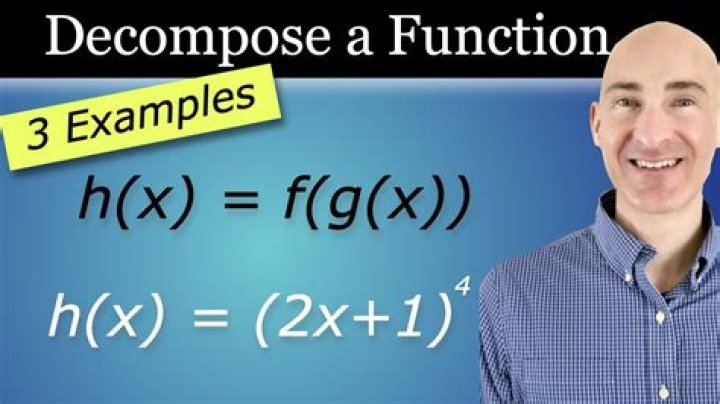
Decompose a function
I have $f(x^2-x)=x$ and I would like to find $f(x)$. Is there a systematic way to do it, which also works for similar composite functions?
$\endgroup$ 12 Answers
$\begingroup$Let $x \in\mathbb R$ and $y = x^2 -x = (x-\frac{1}{2})^2 - \frac{1}{4}$.
Then $x$ is a solution of a second order polynomial equation, so we know that $y\geq -1/4$ and that$$x=\frac{1}{2}(1\pm\sqrt{1+4y})$$
Therefore, $f$ is such that :$$\forall y \geq -\frac 14, f(y) = \frac12(1\pm\sqrt{1+4y})$$
If you assume that $f$ is continuous, then the sign $\pm$ is fixed for all $y$. If you have no condition on $f$, then the sign can depend on $y$.
Also $f$ is arbitrary on $(-\infty, -1/4)$
$\endgroup$ 1 $\begingroup$There's no such function, not without some constraints on domain/codomain:$$x=f(x^2-x)=f((1-x)^2-(1-x))=1-x,$$ so $x$ and $1-x$ can't both belong to the codomain of $f$, if $x\neq1-x$.
You can have a solution for $x$ restricted to $[\frac12,\infty)$, naturally.
$\endgroup$