Cross product of three vectors and Levi-Civita Symbol
I know the basics of Levi Civita and I thought I didn’t have a problem when it comes to calculating the cross product of two vectors. But how and why can we just take the j component of a on the r.h.s of the equation that I share below? And why could we eliminate the basis vector and make it a scalar equation although it should yield a vector? Could you explain the logic behind it?
1 Answer
$\begingroup$Remember that$\epsilon_{kij}\epsilon_{kmn} = \delta_{im}\delta_{jn} - \delta_{in}\delta_{jm}$
so that (I keep the basis vecotrs in the full expansion of the LC symbol)
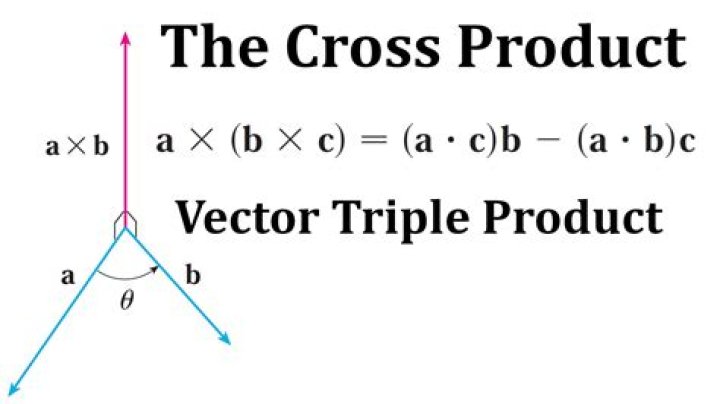
$\vec a \times (\vec b \times \vec c) = \hat e_i \epsilon_{ijk} a_j (\epsilon_{kmn} b_m c_n )$
$ = \hat e_i ( \delta_{im}\delta_{jn} - \delta_{in}\delta_{jm} )a_j b_m c_n $
$ = \hat e_i \delta_{im}\delta_{jn} a_j b_m c_n - \hat e_i \delta_{in}\delta_{jm} a_j b_m c_n$
$ = \hat e_i a_j b_i c_j - \hat e_i a_j b_j c_i $
You may want to double check these indices are in the correct spot.
$\endgroup$