Cosine double angle formula for complex number angles
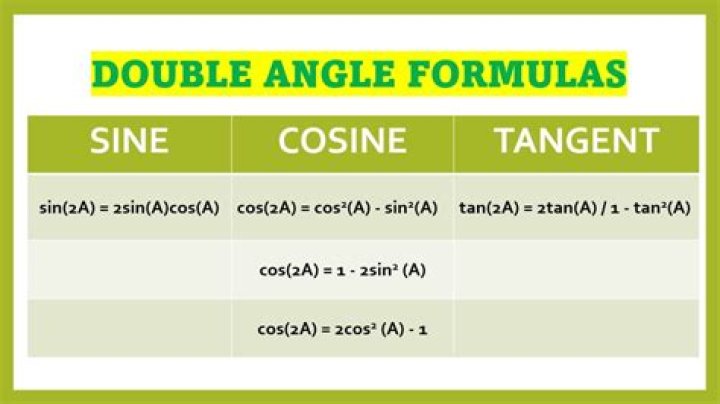
I have just learned Euler's formula: $e^{i\theta}=\cos(\theta)+i\sin(\theta)$, and I was wondering how it could be used to prove $\cos(\theta)=2\cos(\theta)^2-1$. I have begun working on the proof but I seem to be stuck once I get to the following part: $$e^{2i\theta}=(e^{i\theta})^2$$ $$e^{2i\theta}=(\cos(\theta)+i\sin(\theta))^2$$ $$e^{2i\theta}=(\cos^2(\theta)-\sin^2(\theta))+2i\sin(\theta)\cos(\theta)$$ How would I continue the rest of the proof without assuming anything about trig identities with complex numbers? Thank You!
EDIT: Using the first reply, I got the proof to: $$e^{2ix}=2\cos^2(x)+1 + 2i\sin(x)\cos(x)$$ But I am not entirely sure what else he meant and how to continue
EDIT 2: Specifically for complex angles
$\endgroup$ 32 Answers
$\begingroup$You have correctly shown that $$ e^{2i\theta}=\color{#C00000}{\cos^2(\theta)-\sin^2(\theta)}+i\,\color{#00A000}{2\sin(\theta)\cos(\theta)} $$ but using Euler's formula again, we have $$ e^{2i\theta}=\color{#C00000}{\cos(2\theta)}+i\color{#00A000}{\sin(2\theta)} $$ Look at the real parts of each and remember that $\sin^2(\theta)+\cos^2(\theta)=1$.
For complex angles, you may want to use the identity (which follows from Euler's formula) $$ \cos(z)=\frac{e^{iz}+e^{-iz}}2 $$ Then using $$ \cos^2(z)=\frac{e^{2iz}+2+e^{-2iz}}4 $$ and $$ \cos(2z)=\frac{e^{2iz}+e^{-2iz}}2 $$ will give you the desired identity.
$\endgroup$ 5 $\begingroup$I will use different notation if we are talking about trigonometric functions of a complex number $z$. First, Euler's identity for general complex $z$ is $$e^{iz} = \cos z + i \sin z, \quad z \in \mathbb{C}.$$ Therefore, $$\cos z = \frac{e^{iz} + e^{-iz}}{2}.$$ Consequently, $$\begin{align*} \cos 2z &= \frac{e^{2iz} + e^{-2iz}}{2} \\ &= \frac{(e^{iz})^2 + 2 + (e^{-iz})^2}{2} - 1 \\ &= \frac{(e^{iz})^2 + 2e^{iz}e^{-iz} + (e^{iz})^2}{2} - 1 \\ &= 2 \left( \frac{e^{iz} + e^{-iz}}{2} \right)^2 - 1 \\ &= 2 \cos^2 z - 1. \end{align*}$$
$\endgroup$ 2