$\cos(x-90)$ and $\cos(-(x-90))$ how can they be the same?
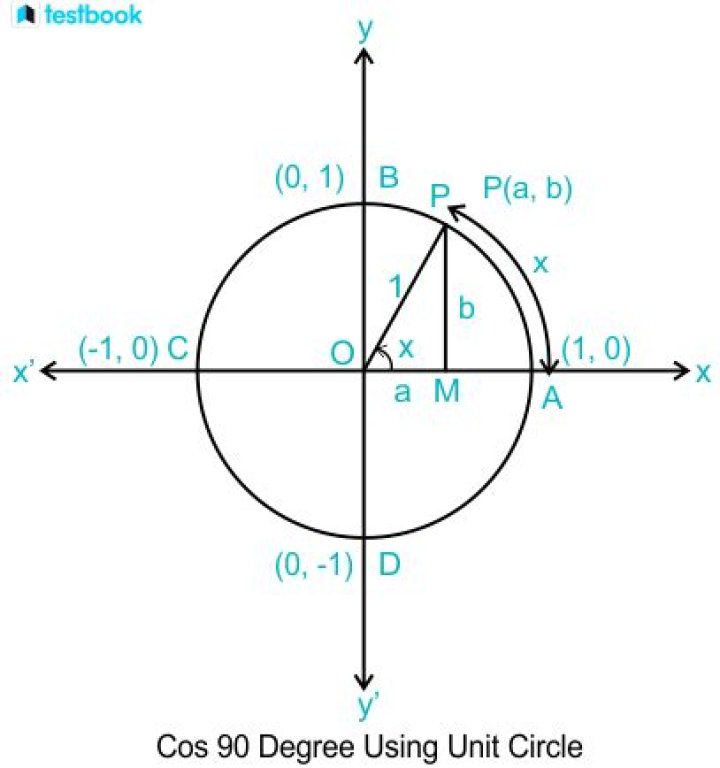
I plotted two lines in Desmos Calculator.
$\cos(x-90)$ which looks exactly like a $\sin x$ graph.
$\cos (-(x-90))$ which looks exactly the same.
However, I thought that $f(-x)$ reflects the entire line in the $y$-axis.
So why do the two lines above look the same, based on graph transformations?
I might be stupid, but just a question.
$\endgroup$ 32 Answers
$\begingroup$Don't make confusion with the parity of a function. The parity transformation only acts on the variable.
$$F(x) ~~~ \text{becomes} ~~~ F(-x)$$
And it is said to be even when $$F(-x) = F(x)$$
But again: the parity does act only on the variable.
For example: take $F(x) = 3x^2 - 4$
Then
$$ F(-x) = 3(-x)^2 - 4 = 3x^2 - 4 $$
The function is then identical to the original one hence it's even .
Notice that we do not change the sign of the constant $4$.
Cosine is an even function :
$$\cos(x) = \cos(-x)$$
But in your case the parity does not attack $90$. Under the parity your function becomes:
$$\boxed{\cos(x - 90) \to \cos(-x - 90)}$$
And they are identical.
$\endgroup$ 7 $\begingroup$The reason is the cosine function is even: $\cos(-\alpha)=\cos\alpha$.
$\endgroup$ 0