Coordinate Geometry - Area of a Quadrilateral
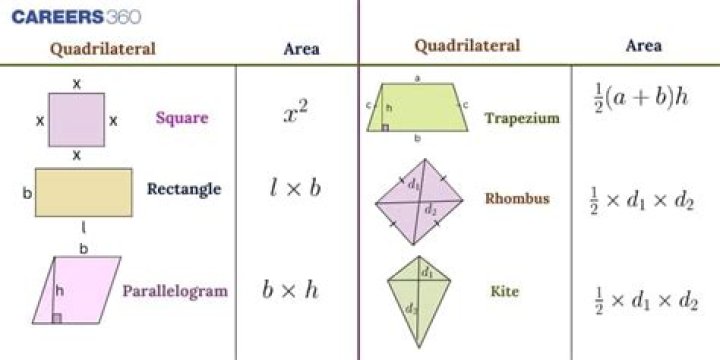
What is the area in square units, of a quadrilateral whose vertices are $$(5,3), (6,-4), (-3,-2), (-4,7)?$$
I have tried creating the triangles, but didn't know how to find the diagonal. I wanted to try the shoelace method but I thought it only worked for triangles. The answer that was provided is $69$.
$\endgroup$ 66 Answers
$\begingroup$There's a neat method we can use in this case called the shoelace formula (which is derived from just adding triangles together, and is applicable in the case where we just have list of the coordinate points).
Application of this formula gives us that the area is
$$\begin{align}A&=\frac{1}{2}\left|x_1y_2+x_2y_3+x_3y_4+x_4y_1-x_2y_1-x_3y_2-x_4y_3-x_1y_4\right| \\&=\frac{1}{2}\left|5\cdot(-4)+6\cdot(-2)+(-3)\cdot7+(-4)\cdot3-6\cdot3-(-3)\cdot(-4)-(-4)\cdot(-2)-5\cdot7\right| \\&=\frac{1}{2}\left|-20-12-21-12-18-12-8-35\right| \\&=\frac{1}{2}\left|-138\right| \\&=69 \end{align}$$
$\endgroup$ 1 $\begingroup$Let $A(5,3), B(6,-4), C(-3,-2), D(-4,7)$.
The area of $\triangle ABC$ is given by $$\frac{1}{2}\sqrt{\left|\vec{AB}\right|^2\left|\vec{AC}\right|^2-\left(\vec{AB}\cdot \vec{AC}\right)^2}.$$ One can get the area of $\triangle{ACD}$ in the same way as above.
Added : Since $$\vec{AB}=(6-5,-4-3)=(1,-7)$$$$\vec{AC}=(-3-5,-2-3)=(-8-5)$$$$\vec{AB}\cdot \vec{AC}=1\cdot(-8)+(-7)\cdot (-5)=27,$$one has $$\frac{1}{2}\sqrt{\left|\vec{AB}\right|^2\left|\vec{AC}\right|^2-\left(\vec{AB}\cdot \vec{AC}\right)^2}=\frac{1}{2}\sqrt{(1+(-7)^2)\cdot((-8)^2+(-5)^2)-27^2}.$$
$\endgroup$ 4 $\begingroup$From the diagram:
$$11\times 10-\frac12 \times 9 \times 4 - 4 \times 1 - \frac12 \times 1 \times 7 -\frac12 \times 9 \times 2 - 2 \times 1 - \frac12 \times 1 \times 9$$ $$= 110-18-4 -3.5-9-2-4.5 =69$$
You want a really easy way to do this?? Check this out!
Given the four vertices: (5,3),(6,−4),(−3,−2),(−4,7), find the Area:
(1) Determine the diagonal "vectors" (by subtracting the opposite vertices):
d1 = (5, 3) - (-3,-2) = (8, 5)
d2 = (6,-4) - (-4, 7) = (10,-11)
(2) The area equals 1/2 of the absolute value of the "cross-product" of the diagonals:
X = 1/2 * | (8 * -11) - (10 * 5) | = 1/2 * 138 = 69.This works for any irregular quadrilateral.
$\endgroup$ 0 $\begingroup$Use the formula
Area of Triangle = 1/2(x1(y2−y3)+x2(y3−y1)+x3(y1−y2)
Join the diagonal (any one) then find the area of two triangles formed by above formula
A(x1,y1), B(x2,y2), C(x3,y3), D(x4,y4) are verticies of a quadrilateral either convex or concave (one of the internal angle greater than 180 degrees) taken in order, then we can use the following elegant formula for calculating it's area.
A= 1/2*abs((xi-x3) *(y2-y4) -(x2-x4) *(y1-y3))
$\endgroup$ 3