Convexity and concavity with Hessian matrices
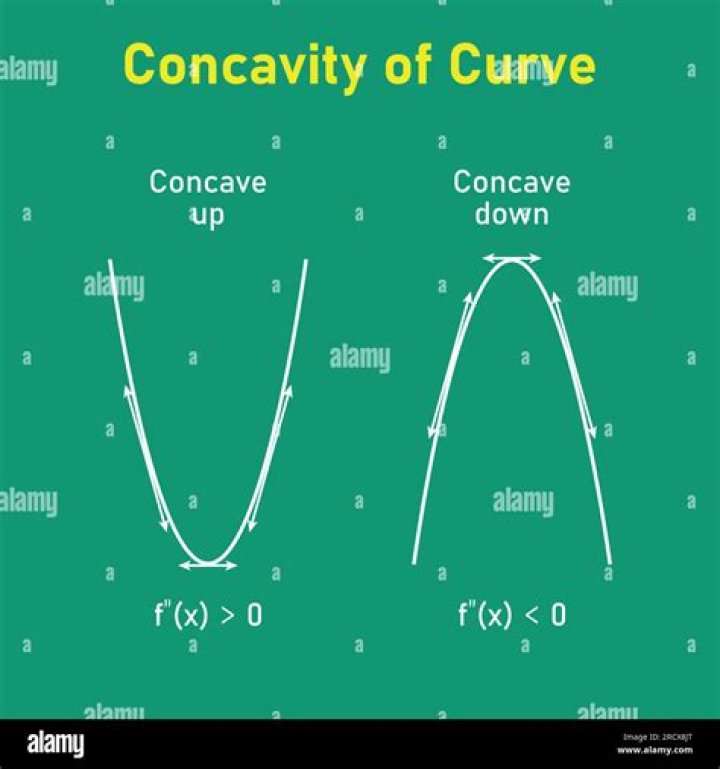
I want to analyze two Hessian matrices regarding definiteness to formulate conclusions whether the functions are convex or concave.
If you could check my thoughts, I’d be grateful.
$H_1(x)=\left ( \begin{matrix} -4b-3&0 &0 \\ 0& -8 & 0\\ 0& 0& 0 \end{matrix} \right )\\\\ \lambda_1=-4b-3, \lambda_2=-8,\lambda_3=0, b>0\\\\$
I would argue $H_1(x)$ is semi-negative definite, because two of two negative eigenvalues and a zero. Hence $f_1(x)$ is concave. Is it important to note that it is symmetric?
$H_2(x)=\begin{pmatrix} -3 &4 \\ 4&-9 \end{pmatrix}\\\\ \lambda_1=-11, \lambda_2=-1$
I would argue $H_2(x)$ is negative definite, since both eigenvalues are negative. Hence $f_2(x)$ is concave. And again, is the symmetry important for the convexity/concavity?
Two things concern me.
First, there is a difference of the matrices, one is negative definite, the other is semi-negative definite. Is that $f_2(x)$ is strictly concave then?
Second, how would I apply the determinant criterion? edit: no need for applying at all
1 Answer
$\begingroup$I will answer some of your questions.
The entries of a Hessian matrix $H$ of $f$ are second partials $H_{ij}=\partial_i\partial_jf$ and it is a standard result in multivariable calculus that $\partial_i\partial_jf=\partial_j\partial_if$ provided both second partials are continuous functions. In your case, the entries of the Hessian are constants so are continuous functions. This means that it is not at all accidental that the matrix is symmetric.
By the spectral theorem, symmetric matrices can always be diagonalised, so the symmetry of the matrix does play a role in allowing one to determine whether the Hessian is positive/negative (semi) definite. Provided you found the eigenvalues correctly, you have drawn the correct conclusion about $H_1$ and $H_2$.
Finally, if the Hessian is positive/negative definite then yes it will be strictly convex/concave.
$\endgroup$ 2