Converting Cartesian equation in form x = y = z into Vector Equation
The question is:
Find the vector equation of the line with Cartesian equation:
$$5x + 1 = -10y - 4 = 2z$$
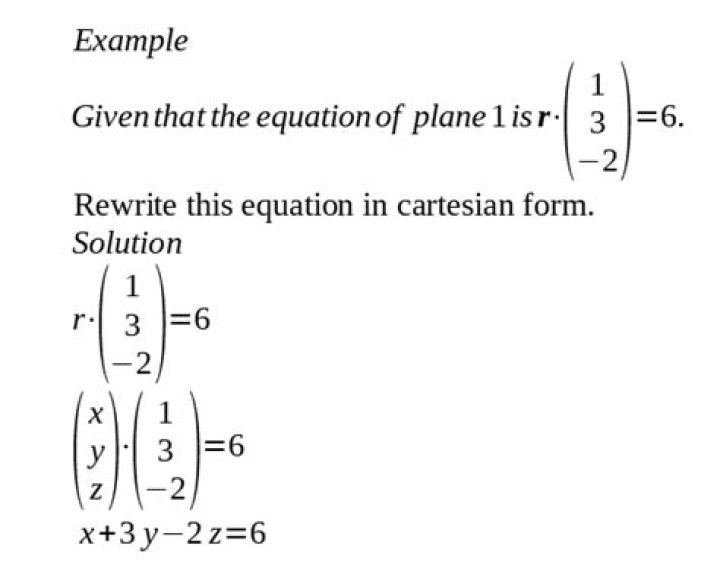
I know the vector equation of a line is $\textbf{r} × \textbf{v} = \textbf{a} × \textbf{v}$, where $\textbf{r}$ is the position vector of a point on the line, $\textbf{a}$ is a fixed point on the line, and $\textbf{v}$ is a direction vector for $\textit{L}$. What I don't get is how the Cartesian equation can give me what I need.
If someone could please explain the process of converting Cartesian into vector form and highlight the link between Cartesian and vector equations of lines that would be great.
$\endgroup$ 22 Answers
$\begingroup$Hint:
You have: $$ 5x + 1 = -10y - 4 = 2z=t $$
so: $$ x=\frac{t-1}{5} \qquad y=\frac{t+4}{-10} \qquad z=\frac{t}{2} $$
can you find a vector equation from this?
(It has the form $\vec x= t \vec v+ \vec w$)
$\endgroup$ $\begingroup$You need to convert the given eqn into a form like
$\frac{x-a}{a'} = \frac{x-b}{b'} = \frac{x-c}{c'}$
You can do that by dividing by some suitable real and some rearranging( please do it yourself).
The rest ia trivial. The eqn of the line in vector form is then $\vec r = (a,b,c) + \lambda (a',b',c')$ where $(a,b,c) = ai + bj + ck$
How is the vector form achieved from the cartesian form above?
Just take $\frac{x-a}{a'} = \frac{x-b}{b'} = \frac{x-c}{c'} = \lambda$
Then, $x = a + \lambda.a', y = b+ \lambda.b', z = c+ \lambda.c'$
Let $\vec r = (x,y,z)$, then substituting the values of x,y,z e get the required vector eqn.
$\endgroup$ 1