Convert $\sin 2x$ into terms of $\cos 2x$
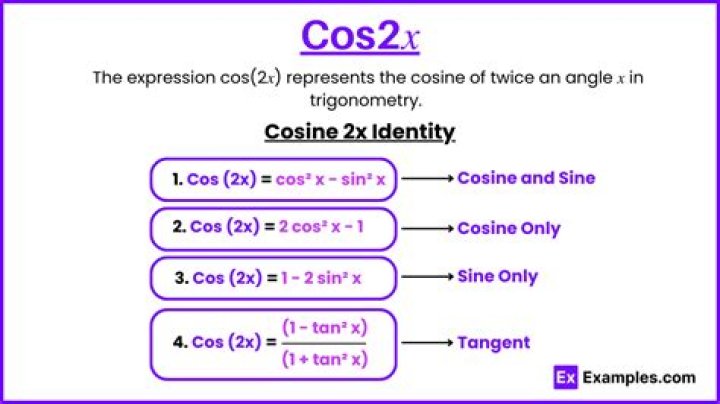
I need to convert a factor of $\sin 2x$ into terms of $\cos 2x$, or any power of $\cos 2x$. Basically I need to solve an equation by substituting $r = \cos 2x$ and solve for $r$, but I am stuck with a factor of $\sin 2x$, and I am not able to get rid of it. Is it even possible?
I have managed to find that
$$ \sin 2x = \frac{2\cos 2x \tan x}{1 - \frac{1 - \cos 2x}{1 + \cos 2x}} $$
but now I'm stuck with a tangent function.
Obviously I tried using
$$ \sin 2x = \sqrt{1 - \cos^2 2x} $$
but that only gives the positive values of the sine function, and I need all values.
Update after 5 years
I should of course have added more information when I opened this question all these years ago. I came up with a solution, which was briefly outlined in my MSc thesis (in chemistry, not mathematics). Screenshot below.
and equation 2:
2 Answers
$\begingroup$We know,
$\sin^2 2x + \cos^2 2x = 1$
$\cos^2 2x = 1 - \sin^2 2x$
$\cos 2x = \pm \sqrt{1 - \sin^2 2x}$
$\endgroup$ 2 $\begingroup$Of course you can say $\sin(2x) = \pm \sqrt{1 - \cos^2(2x)}$, consider each of the $+$ and $-$ cases separately, and see which values of $x$ give you solutions to the original equation.
Or you can look for alternative approaches. If one technique is not looking good, try another for a bit. Maybe you will end up returning to the first technique, but maybe you will find the solution a different way.
If you were going to go with your first attempt, you can still make it a lot simpler, because$$ 1 - \frac{1 - \cos(2x)}{1 + \cos(2x)} = \frac{(1 + \cos(2x)) - (1 - \cos(2x))}{1 + \cos(2x)} = \frac{2 \cos(2x)}{1 + \cos(2x)} $$
and therefore$$ \frac{2\cos(2x) \tan x}{1 - \frac{1 - \cos(2x)}{1 + \cos(2x)}} = 2\cos(2x) \tan x \left(\frac{1 + \cos(2x)}{2 \cos(2x)}\right) = (1 + \cos(2x))\tan x. $$
You could apply the half-angle tangent formula to get rid of the tangent: letting $\theta = 2x,$$$ \tan x = \tan\frac\theta2 = \pm\sqrt{\frac{1 - \cos\theta}{1 + \cos\theta}} = \pm\sqrt{\frac{1 - \cos(2x)}{1 + \cos(2x)}}, $$but this is not obviously better than $\sin(2x) = \pm \sqrt{1 - \cos^2(2x)}$.
Another possible technique is to use $\sin x$ and $\cos x$ instead, using $\sin(2x)=2\sin x\cos x$ and $\cos(2x) = 2\cos^2 x - 1$and hoping that the extra $\sin x$ gets canceled somehow.
But more likely the solution is to take another step back into the larger problem that you have not shown us and to look for a way that does not require directly solving the equation in $\sin(2x)$ and $\cos(2x)$ that you thought you had to solve.
You cannot get any help with the larger problem if you present only a very tiny glimpse into just one step of your (so far unsuccessful) attempt to solve the larger problem. That is why one of the comments referred to the XY Problem.
$\endgroup$