Converse of the exterior angle bisector theorem
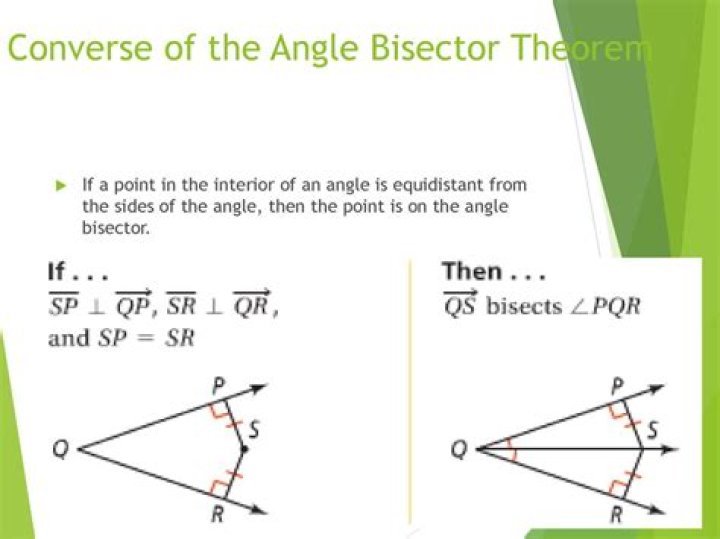
How to prove the following theorem? In triangle ABC the point P divides the extension of the line AB in the following ratio AP:BP=AC:BC. Prove that the line CP is the bisector of the exterior angle C. Trigonometric solution is possible.
$\endgroup$ 11 Answer
$\begingroup$$\mathrm{Fig. 1}$ shows the triangle $ABC$ and the line $CP$ mentioned in your question. We need to draw the line $BD$ parallel to $PC$ to facilitate our proof. We can write right away,$$\frac{AP}{BP}=\frac{AC}{CD}. \tag{because PC $\backslash\backslash$ BD}$$But, it is given that,$$\frac{AP}{BP}=\frac{AC}{BC}.$$Therefore,$$\frac{AC}{CD}=\frac{AC}{BC},$$which means $CD=BC$. That makes $BCD$ an isosceles triangle and , as a consequence,$$\measuredangle DBC=\measuredangle CDB.\tag{1}$$Because they are alternate angles, The two angles $\measuredangle BCP$ and $\measuredangle DBC$ are equal, i.e.$$\measuredangle PCB=\measuredangle DBC.$$The two angles $\measuredangle ECP$ and $\measuredangle CDB$ are corresponding angles. That makes them equal angles too, i.e.$$\measuredangle ECP =\measuredangle CDB.$$Finally, because of the identicalness seen in the equation(1), we have, $$\measuredangle PCB =\measuredangle ECP.$$
$\underline{Note}$:
You could have refer to a good book on elementary geometry for this proof, because they usually provide the proofs of the exterior angle bisector theorem and its converse side by side under the heading $Euclid\space VI\space 3$. If you have done that, you could have avoided this days-long waiting.