Continuous function proof by definition
Prove that if $f$ is defined for $x\ge 0$ by $f(x)=\sqrt x$, then $f$ is continuous at every point of its domain.
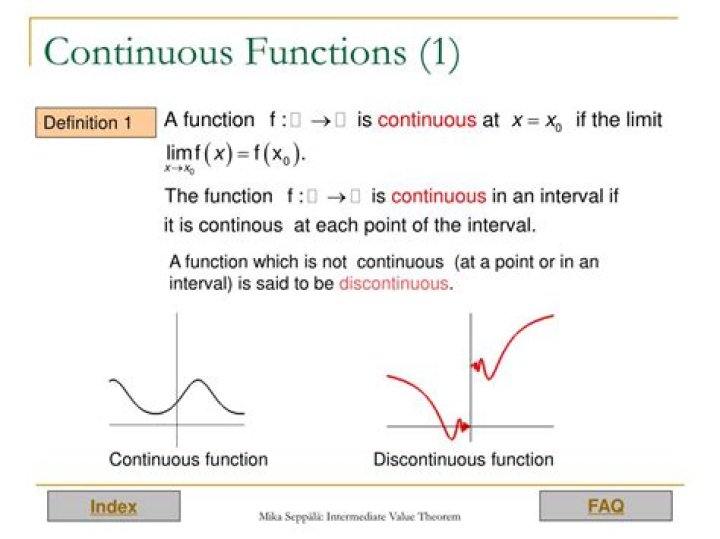
Definition of a continuous function is:
Let $A\subseteq\mathbb{R}$ and let $f:A\to\mathbb{R}$. Denote $c\in A$.
Then $f(x)$ is continuous at $c$ iff for every $\varepsilon>0$, $\exists$ $\delta>0$ such that
$|x-c|<\delta\implies |f(x)-f(c)|<\varepsilon.$
My attempt:
We know that the function $f: x\to \mathbb{R}$, where $x\in [0,\infty)$ is defined to be $f(x)=\sqrt x$. So, for $0\le x<\infty$, then $|f(x)-f(c)|=|\sqrt x - f(c)|$ and I can't continue since I don't necessarily know what $c$ is in this case.
$\endgroup$ 53 Answers
$\begingroup$Let us go from the definition you gave:
$f(x)$ is continuous at $c$ iff for every $\varepsilon>0$, $\exists$ $\delta>0$ such that
$|x-c|<\delta\implies |f(x)-f(c)|<\varepsilon.$
Given $\varepsilon > 0$ we must show that $\vert \sqrt x - \sqrt c \vert < \varepsilon$ provided that $x$ and $c$ are close enough.
$$\vert \sqrt x - \sqrt c \vert = \frac {\vert x - c \vert} {\vert \sqrt x + \sqrt c \vert} < \frac {\vert x - c \vert} {\sqrt c} $$So, $\delta = \varepsilon \sqrt{c}$ will do.
As pointed out by Ian, the above argument fails for $c = 0$. For $c = 0$, given $\varepsilon >0$, $\delta = \varepsilon^2$ would suffice.
$\endgroup$ 15 $\begingroup$The answer above is not an answer. Try to show that the square root function is continuous at the point $c=0$ for the "choices" of $\delta$ given above and see the bizarre world that you end up in. More frustratingly, the people giving the answers make bigger mistakes or have bigger confusions about continuity than the person asking for continuity: for a detailed explanation on how to show that the square root function is continuous, here is a Pdf file that gives a detailed example. LINK
$\endgroup$ 0 $\begingroup$user62089's answer is not quite right. At $c \neq 0$, user62089's work proves that $\delta = \varepsilon \sqrt{c}$ is sufficient. At $c=0$ you have a slightly different situation: you want $\delta>0$ so that $\sqrt{x}<\varepsilon$ for $x<\delta$. $\delta=\varepsilon^2$ works for this purpose.
$\endgroup$