Consistent formula for Regular Polyhedral Volumes
Back in high school I re-discovered the formula for regular polygonal areas like so:
$$A = nx^2\frac{\cot(\pi/n)}{4}$$
Where $A$ was the area of the regular polygon, $n$ was the number of sides and $x$ was the length.
I spent ages trying to figure out the general $3$D version of this, working out the volume of regular polyhedra.
I know that the best way to start is by setting each face as the base of a $z$-gonal pyramid and working out the volume of each pyramid, and summing it up.
$$V = \frac{1}{3}f.A.h = \frac{1}{12}f.nx^2.\cot(\pi/n).h$$
Where $f$ is the number of faces, $n$ is the number of sides on each face, $x$ is the length of each side and $h$ is the height from the center of each face to the center of the polyhedron.
The problem with this is that Euler's Law seems to interfere with reducing the variables of the equation. Trying to reduce $n$ to a value in terms of $f$ is the challenge I've faced over a number of years, to no effect.
What I'm trying to achieve is one formula for all five regular polyhedra.
Has anyone had a similar issue?
$\endgroup$ 32 Answers
$\begingroup$To calculate the volume, use your formula for the area of a regular polygon, and then use the fact that a volume of a pyramid is $Ah/3$.
Apparently, one can show that a general formula for all $5$ regular polyhedra is given by:
$$V = \frac{NnR^3 \lambda \tan(\pi/n)}{\left(1+\lambda^2+\tan^2(\pi/n)\right)^{3/2}}$$ $$ \lambda = \sin ((1-2/N)\pi/n) \left(\sin^2(\pi/n) - \sin^2 ((1-2/N)\pi/n)\right)^{-1/2}$$
Where $n$ is the number of sides for each face, and $N$ is the number of faces.
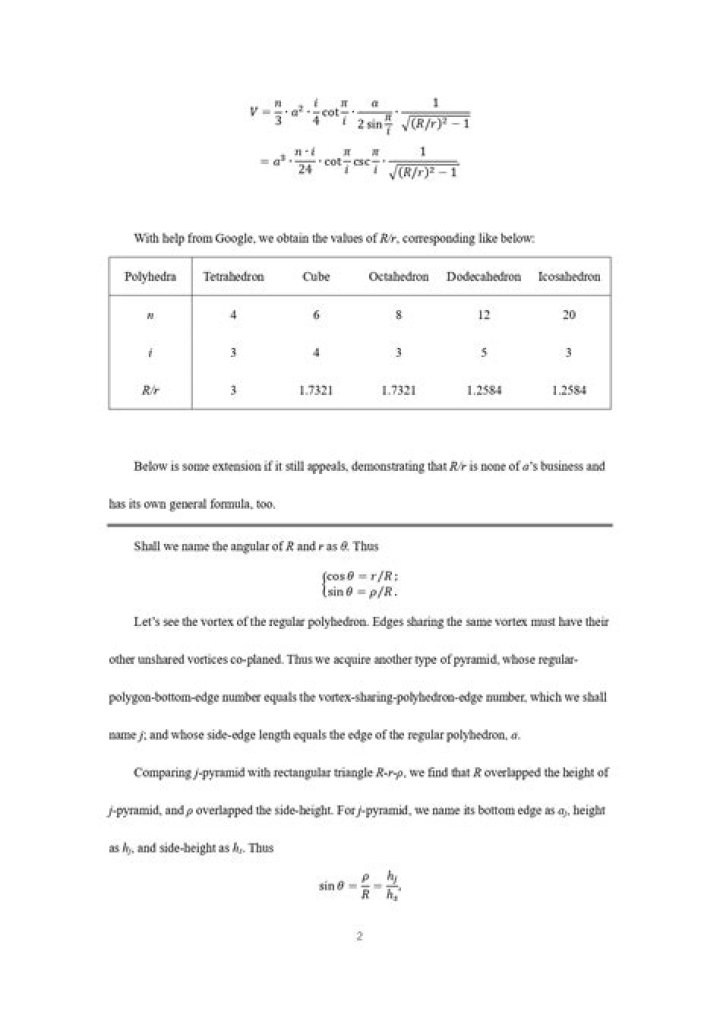
$\endgroup$ 4 $\begingroup$I am inferior at formatting the formula, so shall I upload the images instead.
The general formula for the volume relies on three parameters:
$n$: face number
$i$: edge number of each face
$R/r$: radius ratio of circumsphere and insphere. This one has its own general formula, too, and is none of edge-length's business.
$\endgroup$