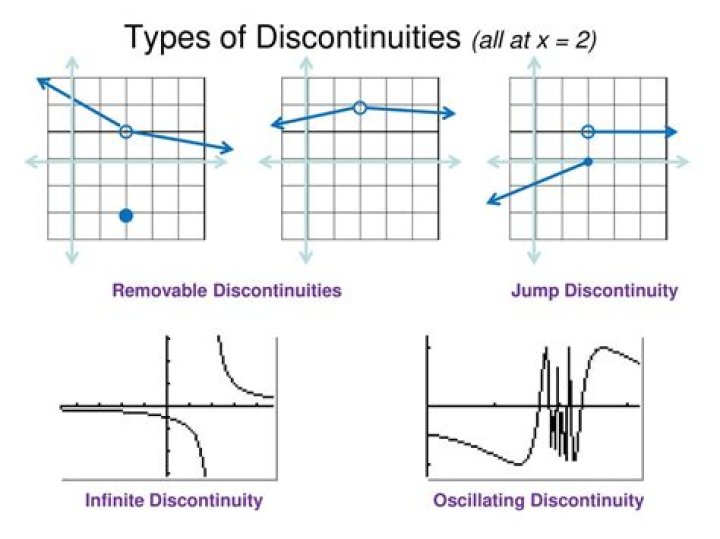
Confusion in Oscillatory Discontinuity - A Peculiar Example
$f: \Bbb R\to \Bbb R$ and $g: \Bbb R\to \Bbb R$
Consider $f(x) = \dfrac{\sin(\frac{1}{x})}{\sin(\frac{1}{x})}$ and $g(x) = 1$.
Is $f(x) = g(x)$? Are $f$ and $g$ identical?
$g(x)$ is definitely constant, and continuous at $x = 0$. What can we say about the continuity of $f(x)$?
As $x$ approaches 0, $1/x \to \infty$ and the argument of sine can take infinitely many values. In fact, several such values will be integral multiples of $\pi$, creating a $0/0$ (indeterminate) form for $f(x)$. So is $f(x)$ continuous? What can we say about the continuity of $f(x)$? Is it continuous in its domain, continuous over $\Bbb R$, or discontinuous at infinitely many points?
In general, if $h(x) = \dfrac{p(x)}{q(x)}$, and $p(x)$ and $q(x)$ show oscillatory discontinuity at one or several points, what can we say about the continuity of h(x)?
A detailed explanation and answers to all the above confusions would greatly help, thanks!
$\endgroup$ 12 Answers
$\begingroup$Is f(x) = g(x)? Are f and g identical?
Well, it depends on how you define their domain. Naturally, one would define the domain of $f$ as $\{x\in\mathbb{R}: \sin\frac{1}{x}\neq0\}$, and the domain of $g$ as $\mathbb{R}$. In this case they are not identical.
However, you can always restrict the $g$ 's domain to match $f$ 's.
g(x) is definitely constant, and continuous at x = 0. What can we say about the continuity of f(x)? As x approaches 0, ... ...or discontinuous at infinitely many points?
Note that $f$ is also constant, whatever its domain is. In particular, $f$ is clearly continuous whether you are using the $\epsilon$-$\delta$ definition of continuity, or the topological definition.
It is important to note that a function can be said to discontinuous in some point, only if it is defined there. Thus, the functions $$F:\mathbb{R}\setminus\{0\}\to\mathbb{R}\\F(x)=\frac{1}{x} $$ is continous. But $$G:\mathbb{R}\to\mathbb{R}\\G(x)=\begin{cases}\frac{1}{x}, &x \neq 0 \\ 0, &x=0\end{cases} $$ is not.
In general, if $h(x) = \dfrac{p(x)}{q(x)}$, and p(x) and q(x) show oscillatory discontinuity at one or several points, what can we say about the continuity of h(x)?
Nothing, examples can be given such that $h$ turns out be continuous, and also such that $h$ turns out to be discontinuous.
$\endgroup$ $\begingroup$As Aston said, $f$ is not $\mathbb R \to \mathbb R$, and $f \neq g$.
$f(x) = g(x)$ wherever $f$ is defined, which is everywhere except $x = 0$ or
$$\sin\left(\frac1x\right) = 0$$ $$\frac1x = n\pi,\space n \in \mathbb Z$$ $$\frac{1}{n\pi} = x$$ $$x \in \{\cdots,\frac{-1}{2\pi},\frac{-1}{\pi},\frac{1}{\pi},\frac{1}{2\pi},\frac{1}{3\pi},\cdots\}$$
And $f$ is continuous on its domain (which excludes these points), and discontinuous at these (infinitely many) points.
There is no oscillatory discontinuity.
$\endgroup$