Concave up down question
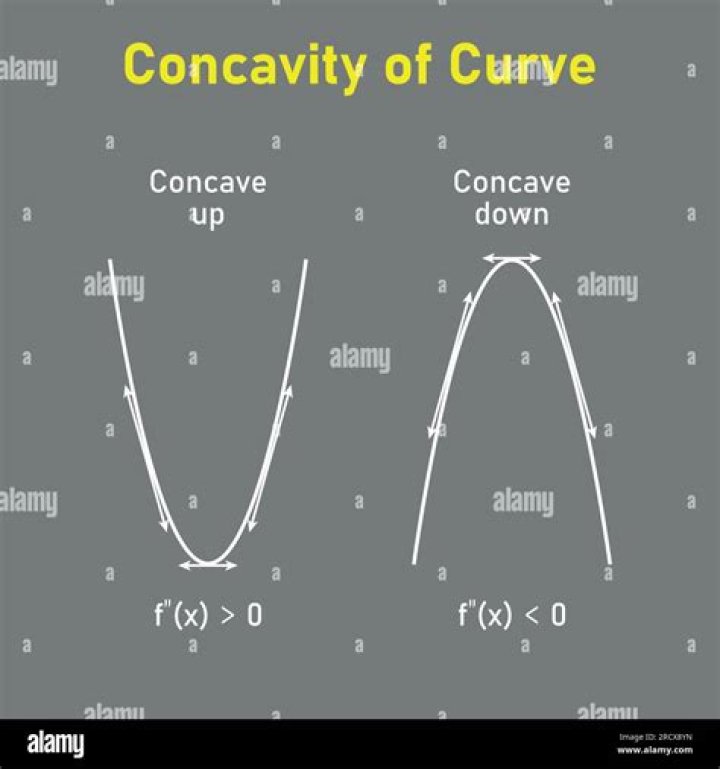
I have quick question regarding concave up and downn.
in the function $f(x)=x\sqrt{4-x}$
the critical point is $\frac{8}{3}$ as it is the local maximum.
taking the second derivative I got $x=\frac{16}{3}$ as the critical point but this is not allowed by the domain so how can I know if I am function concaves up and down assuming I do not havee a graphing calculator.
for my second derivative I got
$f''(x)=6\sqrt{4-x}+\frac{8-3x}{\sqrt{4-x}}/((4(4-x))$
$\endgroup$ 32 Answers
$\begingroup$The calculation looks as if it was done correctly. I get $f''(x)=\dfrac{1}{4}\cdot \dfrac{16-3x}{(4-x)^{3/2}}$ for the second derivative.
The function is defined for $x\le 4$, and its derivatives for $x\lt 4$. When you calculated $f''(x)$, the numerator vanished at $\frac{16}{3}$ only. The second derivative is not defined there, so the second derivative does not change sign over the interval of definition. There is hence no change in concavity.
So to decide on concavity, you can just evaluate the second derivative anywhere in the interior of our interval of definition. The result is negative, so the curve is concave down everywhere.
$\endgroup$ 6 $\begingroup$taking the second derivative I got $x=\frac{16}{3}$ as the critical point
I assume that you mean that you set $f''(x)=0$ and found a solution of $x=\frac{16}{3}$. This is not a critical point. Rather it is an inflection point. In other words, this is where the function changes from concave up to concave down (or vice versa). However, since this value of x is not in the domain of f, there is no inflection point.
On the other hand, you can evaluate $f(\frac{8}{3})$. This gives the concavity at the local extremum. This will tell you whether the graph is concave up or concave down and thus whether this is a local minimum or a local maximum.
$\endgroup$ 1