Composition of a rotation and translation is a rotation with what angle?
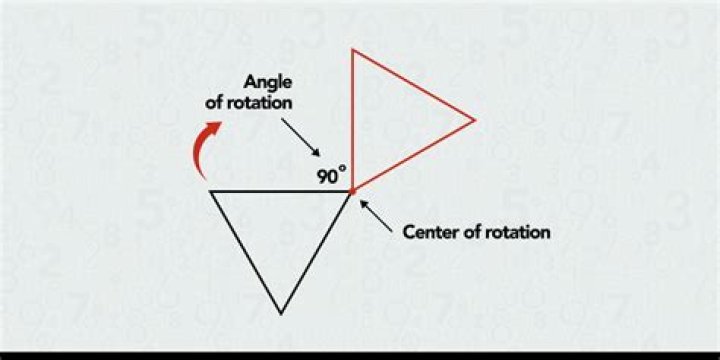
Im trying to figure out what degree exactly you get when you first translate and then rotate or the other way around.
I'm trying it without coordinates in the Euclidian plane.
Let $\delta\in Iso(\mathbb{E})$ a Rotation at Point $P\in\mathbb{E}$ with the angle $2\alpha$ and $\tau=\sigma_b\circ\sigma_a$ ($a\parallel b)$ an Translation.
There exists an $c\perp b$ with $P\in c$ so that we can express the rotation as $\delta=\sigma_d\circ\sigma_c$ with $\sphericalangle(c,d)=\alpha$. This leads to:
$$\delta\circ\tau=\sigma_d\circ\sigma_c\circ\sigma_b\circ\sigma_a$$
Because of $b\perp c$, the composition $\sigma_c\circ\sigma_b=\sigma_b\circ\sigma_c$ comutate . $$\delta\circ\tau=\sigma_d\circ\sigma_b\circ\sigma_c\circ\sigma_a$$
Now $\sigma_c\circ\sigma_a$ and $\sigma_d\circ\sigma_b$ form rotations, whose product is an rotation itself. Because $a\parallel b$ and $b\perp c$ follows $a\perp c$, so $\sigma_a\circ\sigma_c$ forms a rotation with angle $\pm\pi$. So $\sigma_d\circ\sigma_b$ is an rotation with angle $2\sphericalangle(b,d)$. Therefore the composition of both leads to an rotation with angle $\pi+2\sphericalangle(b,d)$.
Because of the fact, that the lines $b,c,d$ gives us a rectangular triangle the angle $\sphericalangle(b,d)=\frac{\pi}{2}-\alpha$.
This leads to the result, that $\delta\circ\tau$ is an Rotation with the angle $2\pi-2\alpha\equiv-2\alpha$ (mod $2\pi$).
Is this correct so far? Whats about the algebraic sign?
If we take a look at the reversed composition, we choose an $d'\perp a$ and $P\in d'$ so that $\delta=\sigma_{d'}\circ\sigma_{c'}$ with $\sphericalangle(c',d')=\alpha$. This leads to:
$$\tau\circ\delta=\sigma_{b}\circ\sigma_{a}\circ\sigma_{d'}\circ\sigma_{c'}=\sigma_{b}\circ\sigma_{d'}\circ\sigma_{a}\circ\sigma_{c'}$$
From the fact that $a,d',c'$ forms a rectangular triangle we derive: $$\pi=\sphericalangle(c',a)+\sphericalangle(a,c')=\sphericalangle(c',a)+(\frac{\pi}{2}-\alpha)\Leftrightarrow\sphericalangle(c',a)=\pi-(\frac{\pi}{2}-\alpha)=\frac{\pi}{2}+\alpha$$
This leads to an Rotation $\tau\circ\delta$ with the angle $\pi+\pi+2\alpha\equiv2\alpha$ (mod $2\pi$).
I dont loose the feeling that there is a sign-error somewhere. Is it correct hat the reverse-composition leads to an oposite rotationangle?
Thanks alot for your help!
$\endgroup$ 4 Reset to default