Complex number to exponential form
How do you transform $\Re(1-z)$ to exponential form (Euler)
Also, how do you transform $|z-1|$ to exponential form?
$\endgroup$ 51 Answer
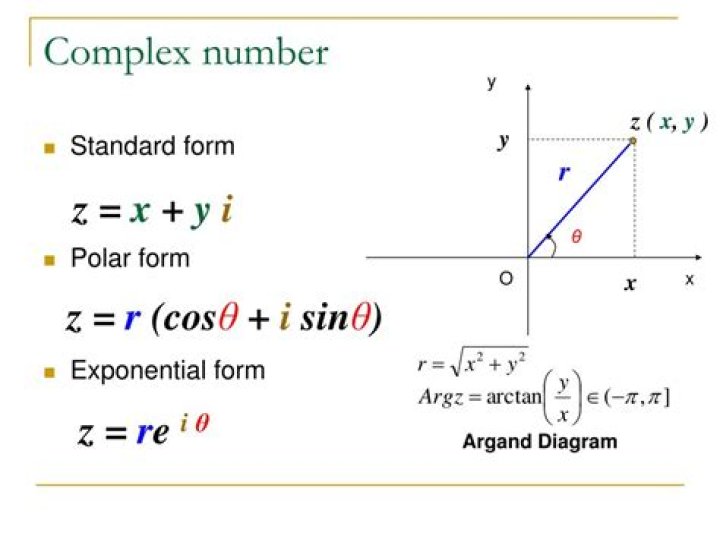
$\begingroup$Let $z = x+iy$, its exponential form comes from identifying it as the point $(x,y)$ in the (Argand) plane. This basically amounts to writing it in what would be polar form in the real plane. Writing it as $$z = re^{i\theta}$$. If you graph the point $(x,y)$ and treat it as a vector its easy to see that $r = |z|$ and $\theta = \tan^{-1}\left(\frac{y}{x}\right)$.
For purely real numbers, they are already in exponential form since they are equal to their modulus and $\theta = 0$.
Also, you can write $$Re(z) = \frac{z+\bar{z}}{2}$$
$\\$
if you want to write it purely in terms of z. Both of your numbers are purely real and thus they are already in exponential form. I suppose if you wanted to be strict about it you could write it as $$|1-z| = |1-z|e^{0i}$$
$\endgroup$