Complement of universal set
What is the complement of the universal set ?
(It can't be the empty set as it's a subset of every set)
$\endgroup$ 26 Answers
$\begingroup$Assuming that in your set theory it is consistent to talk about the universal set and it is $\{x:x=x\}$, then its complement is $$ \{x:x\ne x\} $$ so no set can belong to it. In other words, the complement of the universal set is the empty set.
It's true that $\emptyset$ is a subset of any set, but this has no consequence on the fact above.
$\endgroup$ $\begingroup$It is true that the empty set as it's a subset of every set, but how does this relate to the question?
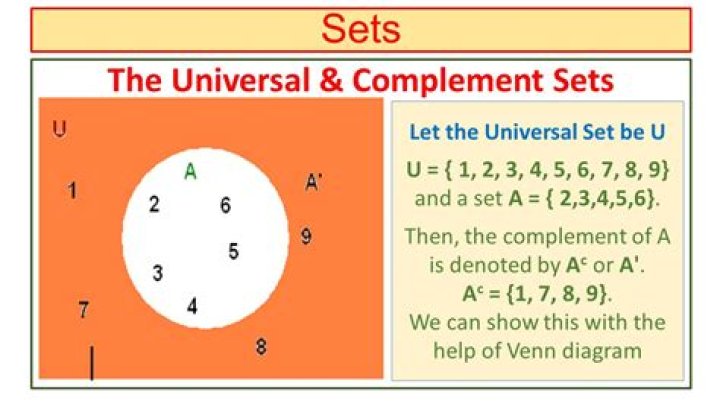
The complement of a set is defined as
$A^C = \{x \in U: x \not\in A\}$, given that $U$ is the universal set.
If $A=U$, then $U^C = \{x \in U: x \not\in U\} = \emptyset$
Plus, if you want to use a "intuitive" understanding, you can see that the universal set is not a subset of any (other) set, while its complement (the empty set) it's a subset of every set.
This makes sense, but anyhow it's just easier to look at the definition
$\endgroup$ 1 $\begingroup$If you work in a universal set $X$, the complement is indeed the empty set $\emptyset$ - and as you state, the emptyset is the only set that's a subset of every set.
$\endgroup$ $\begingroup$It is true that null set is a subset of every set. Let us think this way- when can null set be a subset of U? Only when null set contains an element which is present in U. However, we know that null set or empty set does not contain any element. Therefore, from this angle, empty set becomes a complement of U. Since every object under consideration is included in U, the complement of U must be empty. Thus Ū=null set.
$\endgroup$ $\begingroup$Perhaps it is more intuitive to think in terms of set difference: $A^c = U\setminus A$. What remains if we take all elements of $U$ from $U$?
$\endgroup$ $\begingroup$Don't think about a universal set, $U$, but a set $\Omega$ where all complements are formed relative to that $\Omega$.
Therefore $A^c = \Omega \setminus A$. That is, $x \in A^c \iff x \in \Omega \text{ and } x \notin A$ where $\Omega = A^c \cup A$
If we want to prove $\Omega^c = \emptyset$ we proceed in this way:
$\begin{split} x \in \Omega^c & \implies x \in \Omega \setminus \Omega \\ & \implies x \in \Omega \text{ and } x \notin \Omega \\ & \implies \text{ there is a contradiction} \end{split}$
Therefore $x \notin \Omega^c$ for all $x$. We have also that $x \notin \emptyset$ for all $x$.
Because $\emptyset$ is unique we have that $\Omega^c = \emptyset$.
$\endgroup$