Clarification about the axioms of a subspace
I'm asked to verify if:
$B=(x,y,z) \in \mathbb{R}^3 : ||(x,y,z)|| \leq 1$
is a subspace. I know I have to check for the zero vector, addition and scalar multiplication. Here lies my question however.
If I use $(0,0,0)$ to check if the zero vector exists, it clearly does. However, if I multiply $(0,0,1)$ by some scalar, say, $50$, scalar multiplication does not hold so this isn't a subspace.
Here lies my problem. I thought because the $0$ vector exists, this set MUST be a subspace and hence, scalar multiplication and addition should hold.
Am I wrong in assuming that if $0$ vector exists, all the other axioms must hold? Or is it possible that some axioms work and some fail?
$\endgroup$ 33 Answers
$\begingroup$You have the idea somewhat reversed. If the space is closed under addition and scalar multiplication, then you need to have the zero vector since $$0\cdot (x,y,z)=(0,0,0)$$ and $$(x,y,z)-(x,y,z)=(0,0,0)$$
So in fact the crucial axioms are addition and scalar multiplication. The zero vector comes for free
Edit thanks to comment: The zero vector comes for free after checking the set is non-empty. Just so happens that it is often easy to see that the zero vector is in the space, hence non-empty.So this whole discussion kind of chicken and egg
$\endgroup$ 1 $\begingroup$Of course just checking that the zero vector is there is not enough. Just think about it-how can the existence of a zero vector imply that the subset is closed under addition and scalar multiplication? For example, is $\{0,1\}$ a subspace of $\mathbb{R}$? Clearly not. To check if $S\subseteq V$ is a subspace you need to check the following:
$1. $ The zero vector is in $S$. (or instead of that you can check that $S$ is not empty).
$2. $ $S$ is closed under addition and scalar multiplication.
$\endgroup$ $\begingroup$Am I wrong in assuming that if $0$ vector exists, all the other axioms must hold?
In short, yes. Why else would the other axioms be there?
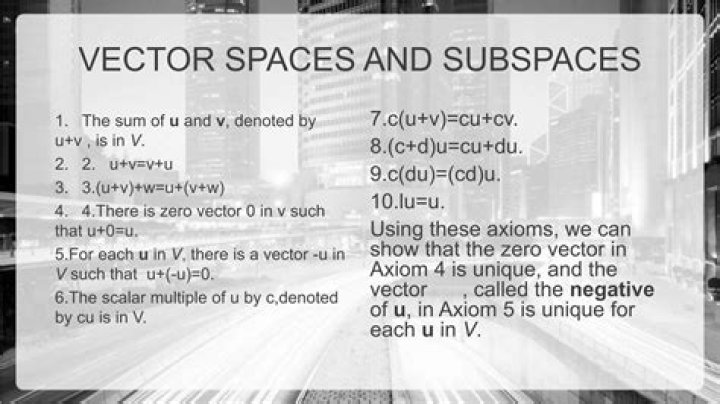
Technically, those aren't axioms. You have axioms describing a vector space, and given a vector space there are certain subsets of that vector space which are themselves vector spaces, using the same operations. Those are what we call subspaces.
So subspaces actually need to fulfill all the same axioms that all other vector spaces do. The checklist you're using (which you call axioms) isn't as long as the full list of vector space axioms, however. The reason is that inheriting the operations from something we know is a vector space gives us a lot for free.
$\endgroup$