Check if system is causal
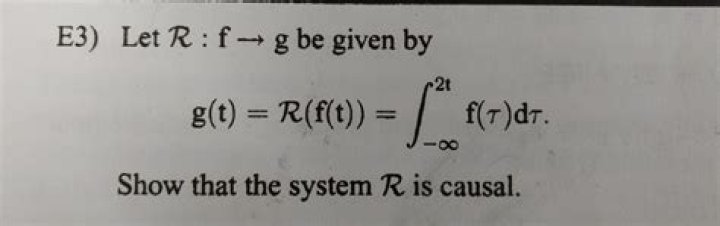
I am a little confused on attached question. For t=1, g(t) =g(1), requires integration upto t=2, which is in future...So how can it be causal? Is it a typo (not causal)?
$\endgroup$1 Answer
$\begingroup$I agree with you. This is not causal.
It looks like a typo. Or perhaps someone fell into the trap of blindly applying the criterion (Wikipedia):
A necessary and sufficient condition for a system to be causal, regardless of linearity, is: the impulse response of the system must use only the present and past values of the input to determine the output.
That is, that $h(t)=0$ for $t<0$. Indeed, if we attempt to obtain the impulse response $h(t)$ of this system by computing the output of a Dirac delta, as $g(t)=\mathcal{R}(\delta(t))$, we get a step function, which corresponds to a causal system. But this is wrong, because the system is not time-invariant, hence it does not have an impulse response (or, if you prefer, it depends on two time indexes).
$\endgroup$ 2