Can the number of diagonals of a given polygon be found using combinations?
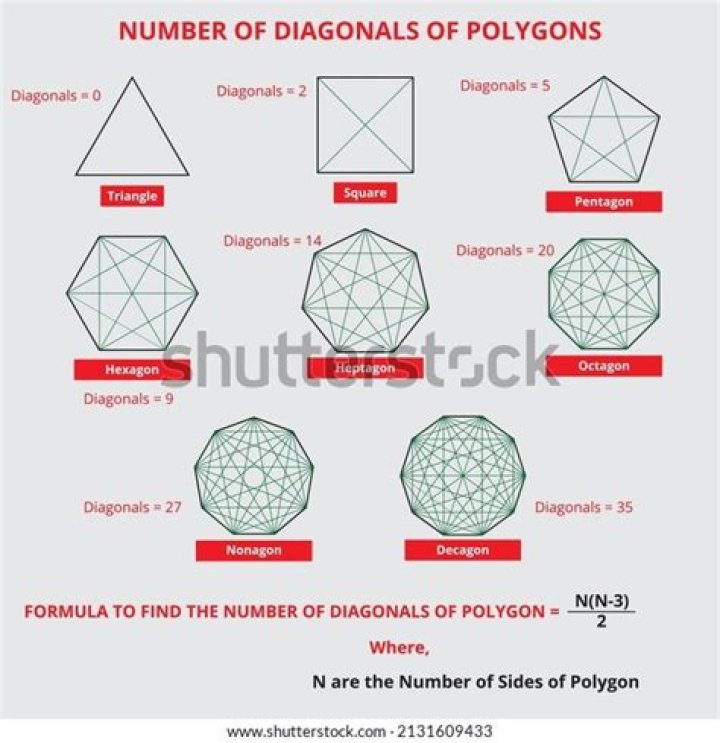
The following question appears in my textbook:
A pentagon has 5 diagonals. How many diagonals has a 15-sided polygon?
After doing some research, I found out that the number of diagonals of an n-sided polygon = $\frac{n(n-3)}{2}$.
This formula works, of course, but the question is one of those in my textbook designated to be solved using combinations. Therefore, if a similar question came up in a test, I could only imagine the correct working out involving combinations.
I can imagine that said formula could be a simplification of $\binom{n}{r}$ = $\frac{n!}{r!(n-r)!}$. However, I'm unsure of the specifics.
$\endgroup$2 Answers
$\begingroup$By a happy coincidence an $n$-sided polygon also has $n$ vertices. A diagonal joins two vertices, which can be done in $\binom n2$ ways. However, this count includes the $n$ sides, so subtract $n$ to get the number of diagonals: $$\binom n2-n=\frac{n(n-1)}2-\frac{2n}2=\frac{n(n-3)}2$$
$\endgroup$ $\begingroup$Each diagonal can be thought of as a pair of vertices (where order doesn't matter), of which there are ${n\choose2} = \frac{n(n-1)}{2}$. This also counts each side, though, so you subtract $n$ to get $\frac{n(n-3)}{2}$.
$\endgroup$